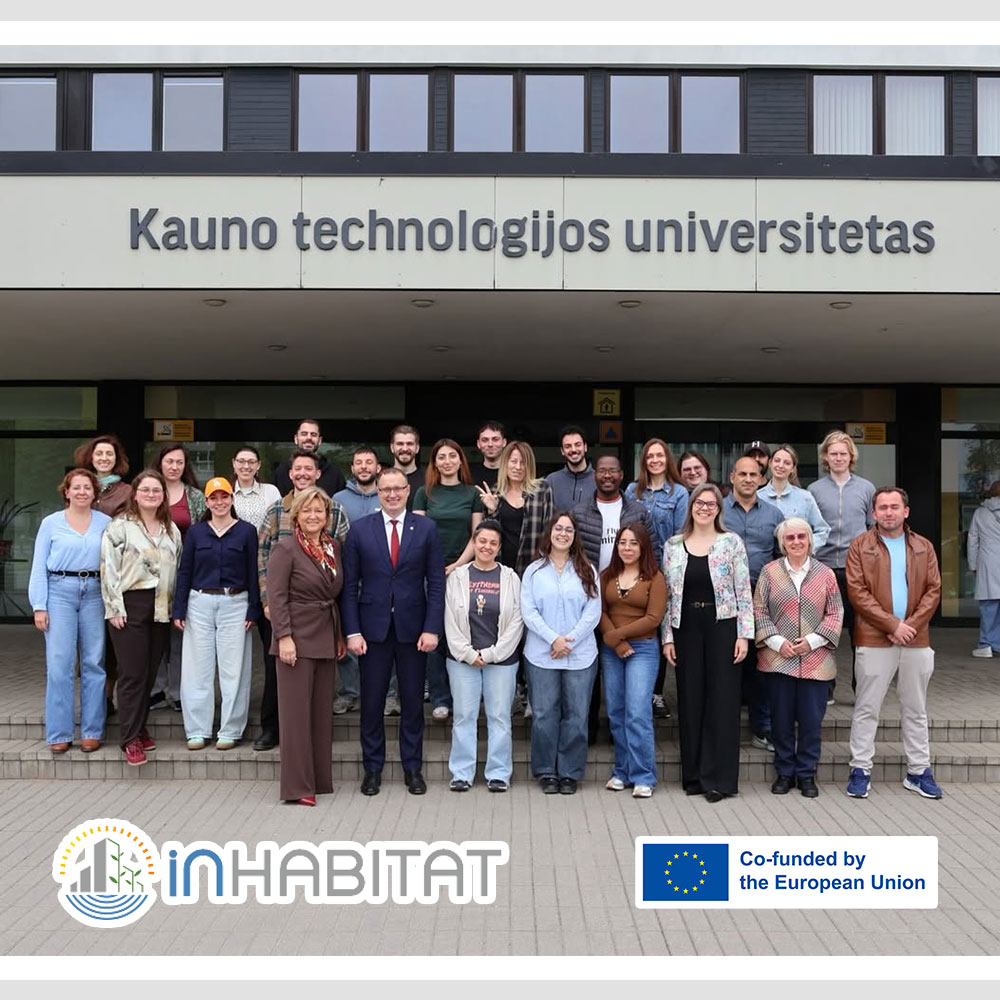
Learning in an international Master’s programme can extend beyond a student’s usual university environment. For the INHABITAT Project students, a two-week mobility period at Kauno Technologijos Universitetas (KTU) in Lithuania provided an opportunity to learn, exchange experiences, and spend time with members of the programme’s international community.
Students and academic staff from INHABITAT Project partner universities came together in Kaunas for two weeks of learning, collaboration and international exchange. During the mobility period, participants had the opportunity to deepen their knowledge, develop new skills and exchange ideas and experiences with people from different countries.
Learning in a Different Academic Environment
Studying at another university also gave participants the chance to experience KTU’s academic environment and student life in Lithuania.
Bringing students and academic staff from different partner universities together in person supported knowledge exchange across the INHABITAT community and helped strengthen connections between the programme’s partner institutions.
The two weeks were also an opportunity for participants to discover Kaunas and experience life in a different European city as part of their studies.
International Mobility in INHABITAT MSc
International mobility forms an important part of the INHABITAT Project, creating opportunities for people from across the programme to meet, share their experiences, and learn together.
A big thank you to Kauno Technologijos Universitetas (KTU) for hosting the INHABITAT Project students and academic staff during their time in Lithuania. 💙
Funding Agency: EACEA – European Education and Culture Executive Agency
Learn more about INHABITAT: https://www.inhabitatmsc.eu/
101108631 — INHABITAT — ERASMUS-EDU-2022-PI-ALL-INNO
Disclaimer: Funded by the European Union. Views and opinions expressed are however those of the author(s) only and do not necessarily reflect those of the European Union or the European Education and Culture Executive Agency (EACEA). Neither the European Union nor EACEA can be held responsible for them.