How to Share Team Responsibilities by Playing to Our Superpowers
Every team member brings distinct skills and interests to a project.
In many collaborative environments, tasks are assigned through rigid, top-down hierarchies rather than being distributed based on who is best suited for them. When we ignore individual strengths, we lose the opportunity for authentic ownership and strength-based leadership.
On 19 November 2026, the EAC EMPOWER Impact Series hosts its next online session: “Playing to Our Superpowers“, organized as a DigiCreate Empower Virtual Exchange
This interactive workshop offers young professionals and youth leaders practical strategies for sharing real-world project tasks based on personal interests and unique contributions.
Continuing Learning Cycle 2: Professional Equity
Running from September 2026 to April 2027, the EAC EMPOWER Impact Series brings together youth workers, trainers, emerging leaders, and young creatives for 30 free weekly online sessions. Through a blend of practical train-the-trainer workshops, Virtual Exchanges, and cross-border peer learning, participants discover tools to support well-being and equitable participation.
The 30 sessions are organised into six progressive thematic cycles:
-
- Safe Space
- Professional Equity
- Mutual Value
- Constructive Validation
- Sustainable Growth
- Self-Awareness
Session 9 continues our second cycle, Professional Equity, by examining how individuals and teams can lead tasks based on their unique superpowers.
Watch the Session 9 Video
Watch our 1-minute introductory video below to explore the core philosophy behind this week’s workshop:
🎬 Watch on YouTube:
What You Will Explore
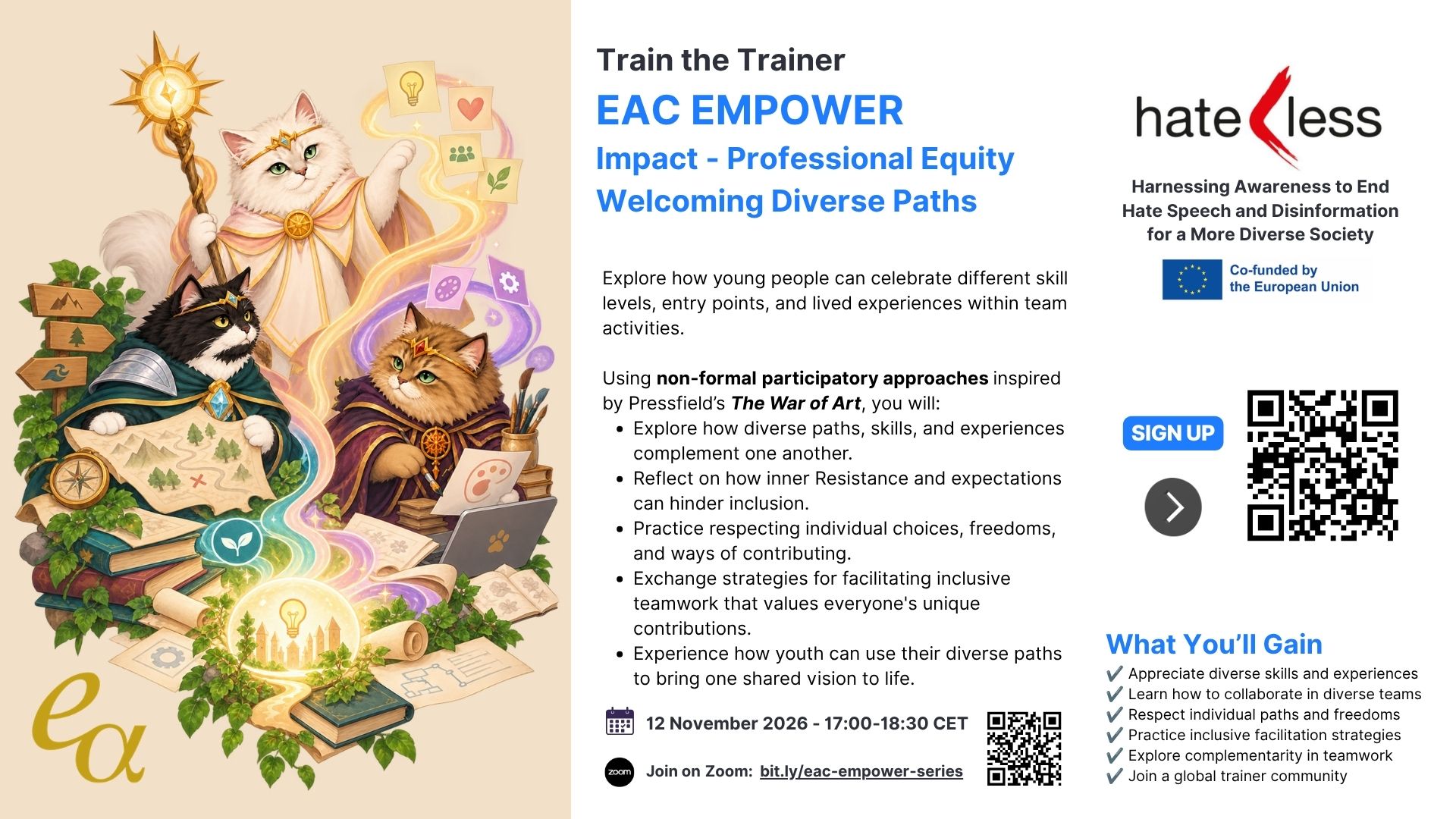
During this interactive 90-minute online workshop, we draw inspiration from Steven Pressfield’s The War of Art and participatory non-formal methods. Together, we will examine:
- Discovering Superpowers: Identify your personal superpowers and how they contribute to teamwork.
- Overcoming Resistance: Explore how inner Resistance can prevent us from taking ownership and stepping into leadership.
- Task Assignment: Practise assigning tasks and leadership roles based on individual strengths and interests.
- Sharing Responsibilities: Exchange strategies for combining strengths, sharing responsibilities, and achieving common goals.
What You Will Gain
By taking part in Session 9, trainers and participants will gain practical tools for their daily work:
- Identify your unique strengths and interests
- Recognize Resistance to taking ownership
- Explore strength-based leadership
- Practice sharing tasks and responsibilities
- Combine superpowers toward shared goals
- Join a global youth exchange
Who Should Attend?
This online virtual exchange session is designed for young people in the cultural and creative industries (CCI) seeking to build confidence in collaborative settings. It is also highly relevant for youth workers, project managers, and team facilitators looking to implement strength-based leadership in their groups. Participants join live via Zoom to engage in small-group activities, guided reflection, and facilitated peer discussions.
Workshop Details & Registration
📅 Date: 19 November 2026
⏰ Time: 17:00-18:30 CET
📍 Location (Zoom): https://bit.ly/eac-empower-series
👉 Direct Sign-up: https://forms.gle/jGVwfAYs9wGd85C5A
🌍 DIGICREATE Empower Event: https://digicreate-empower.eu/event/playing-to-our-superpowers/
Full Series Calendar: https://ea.consulting/empower-impact-series/
Pre-Workshop Checklist
Before the session:
- Complete the direct sign-up form
- Save the Zoom link
- Note the starting time of 17:00 CET
- Visit the DigiCreate event page for more information.
We look forward to welcoming you to Session 9 of the EAC EMPOWER Impact Series.
Learn more about the EAC EMPOWER Impact Series: https://ea.consulting/empower-impact-series/
Funding Agency: EACEA – European Education and Culture Executive Agency
Learn more about DigiCreate: https://digicreate-empower.eu/
101193474 — DigiCreate — ERASMUS-EDU-2024-VIRT-EXCH
Disclaimer: Funded by the European Union. Views and opinions expressed are however those of the author(s) only and do not necessarily reflect those of the European Union or the European Education and Culture Executive Agency (EACEA). Neither the European Union nor EACEA can be held responsible for them.