Staying Calm When Busy: Our MIND Virtual Exchange
How do you protect your inner peace, mental clarity, and creative focus when deadlines pile up, and team demands intensify?
On 15 October 2026, young creatives, educators, youth workers, and emerging leaders gathered online for Session 4 of the EAC EMPOWER Impact Series: Staying Calm When Busy.
The DigiCreate virtual exchange session examined how individuals and teams can maintain emotional safety and composure during demanding project phases.
Drawing on Steven Pressfield’s The War of Art and grounding practices, participants explored how pressure, perfectionism, and deadline anxiety trigger internal Resistance, and how athletes and performers use practical routines to stay grounded under stress.
Three Performance Strategies for Managing Pressure
Participants examined and practiced three core self-regulation strategies introduced by psychologist Dr. Brad Conn:
- Instructional Self-Talk: Replacing evaluative, panic-inducing thoughts (“There are too many things to do. I’ll never finish!”) with direct action cues (“I am prepared. One step at a time.”).
- Routines: Developing routines that help us overcome negative self-talk, distractions, and other forms of Resistance, such as silencing notifications and working on one task without interruption for 25 minutes.
- Process Focus: Shifting attention away from outcome panic (“What if this fails or people judge the final result?”) toward the single manageable action immediately in front of you.
Participants reflected on workplace stress, overlapping deadlines, and communication fatigue, exploring how setting clear digital and interpersonal boundaries protects collective well-being without escalating conflict.
Turning Reflection into M.I.N.D. Guides
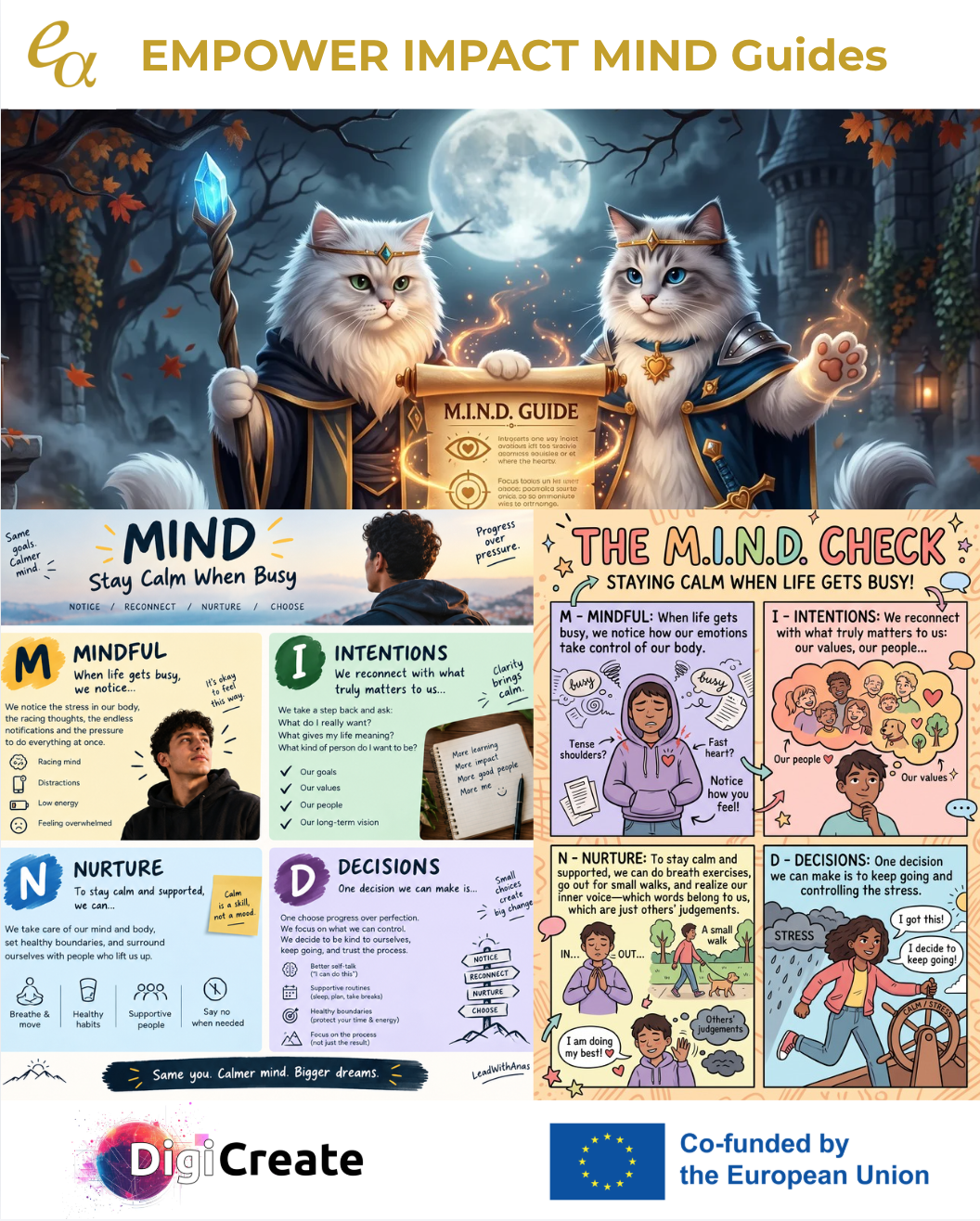
Working with digital tools, participants translated their group reflections into visual guides, videos, stories, and audio narratives built around the M.I.N.D. framework:
- M – MINDFUL: Notice physical tension, mental fatigue, and digital interruptions without harsh self-judgment.
- I – INTENTIONS: Reconnect with your core creative territory, authentic purpose, and collaborative values.
- N – NURTURE: Activate grounding routines, Pomodoro sprints, and screen resets to restore calm.
- D – DECISIONS: Choose clear boundaries and commit to the smallest next step.
A central takeaway guided the exchange: “You cannot always control the pressure around you. But you can protect the calm within you. Breathe, trust your preparation, and take the next step!”
Take a look at the accompanying visual for a preview of the co-created guides. The full collection of participant guides, narratives, videos, and audio stories will be compiled following the conclusion of Cycle 1: Safe Space.
Thank You to Our Participants and Team
Thank you to all participants for bringing your lived experiences, courage, and creative insights to the exchange.
Thank you to our international facilitation team and Dr. Brad Conn for providing the performance tools that grounded our work.
Keep Learning with EAC EMPOWER and DigiCreate
- Explore the EAC EMPOWER Impact Series.
- Access the Cycle 1: Safe Space course on ICARUS.
- Discover the DigiCreate toolbox.
- Register to access the toolbox.
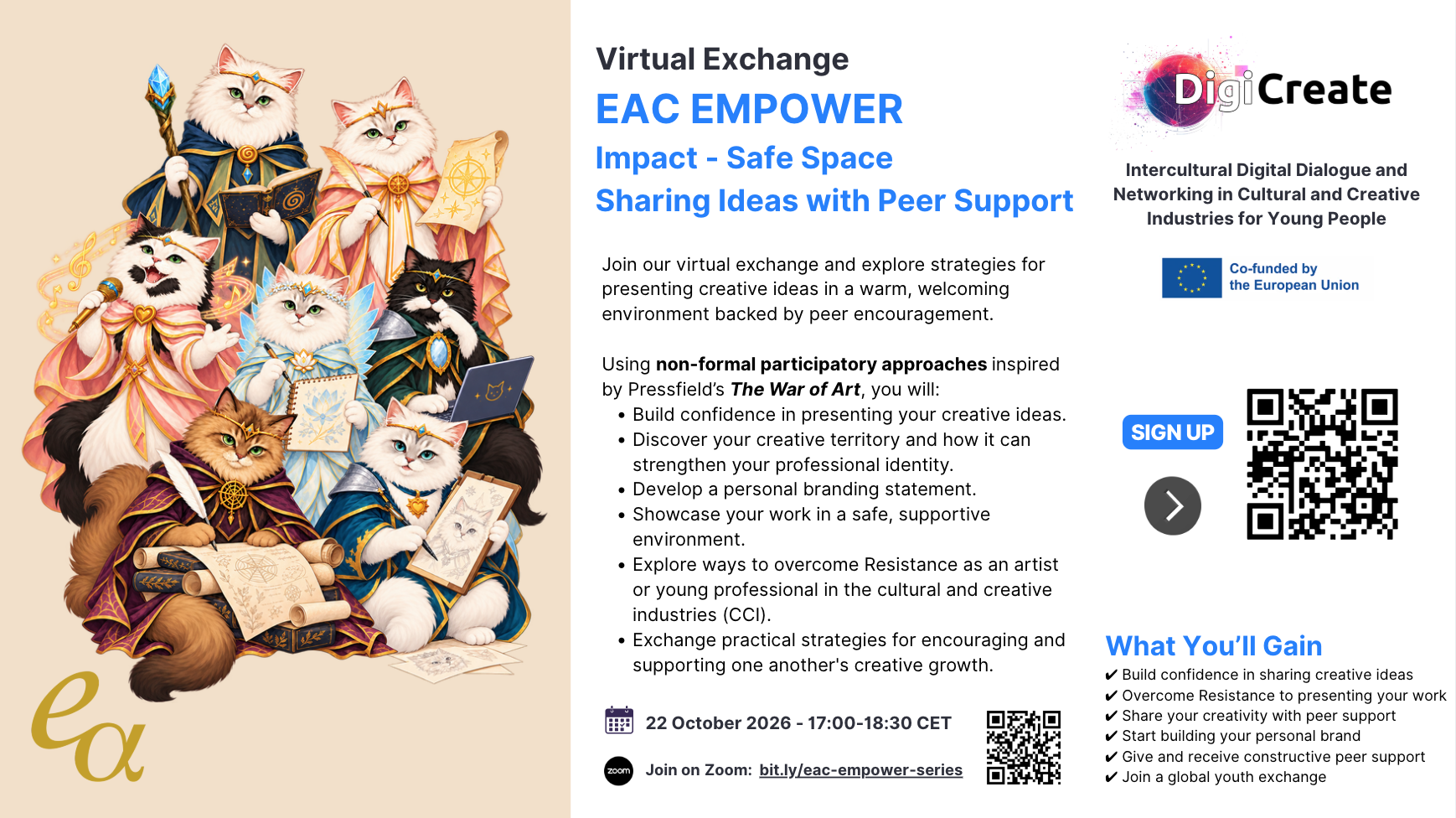
- Learn about our next virtual exchange, Sharing Ideas with Peer Support, on 22 October 2026.
Official Website of the Erasmus+ Virtual Exchange Project DigiCreate: https://digicreate-empower.eu/
Consortium Partners:
- Youth Power Germany EV (YP-DE) (Germany)
- Evolutionary Archetypes Consulting SL (EAC) (Spain)
- Cooperativa Para O Desenvolvimento E Coesão Social, CRL (Contextos) (Portugal)
- Univerzitet Union Nikola Tesla (UniTesla) (Serbia)
- Udruzenje Okret (SPIN) (Bosnia and Herzegovina)
- Nevladina Organizacija GLAS (NVO GLAS) (Montenegro)
- Javna Ustanova Univerzitet Crne Gore Podgorica (UoM) (Montenegro)
- Fakultet Za Poslovnu Ekonomiju I Pravo Bar (FPEP Bar) (Montenegro)
Funding Agency: EACEA – European Education and Culture Executive Agency
101193474 — DigiCreate — ERASMUS-EDU-2024-VIRT-EXCH
Disclaimer: Funded by the European Union. Views and opinions expressed are however those of the author(s) only and do not necessarily reflect those of the European Union or the European Education and Culture Executive Agency (EACEA). Neither the European Union nor EACEA can be held responsible for them.