Bridging Software Architecture and Silicon: The MSL Startup Founders Webinar Series
How do engineering graduates make the transition from academia to leading deep-tech startups?
Across Europe, mastering artificial intelligence and advanced computing systems is critical. Yet understanding how to translate technical prototypes into sustainable ventures, navigating system architecture, commercial viability, and product execution, requires perspectives rarely covered in traditional engineering curricula.
To bridge this gap, consortium leader 28DIGITAL, in collaboration with the EIT Digital Master School, is launching the MSL Startup Founders Webinar Series. This recurring initiative connects Master School students directly with technology founders who share honest reflections on their entrepreneurial journeys.
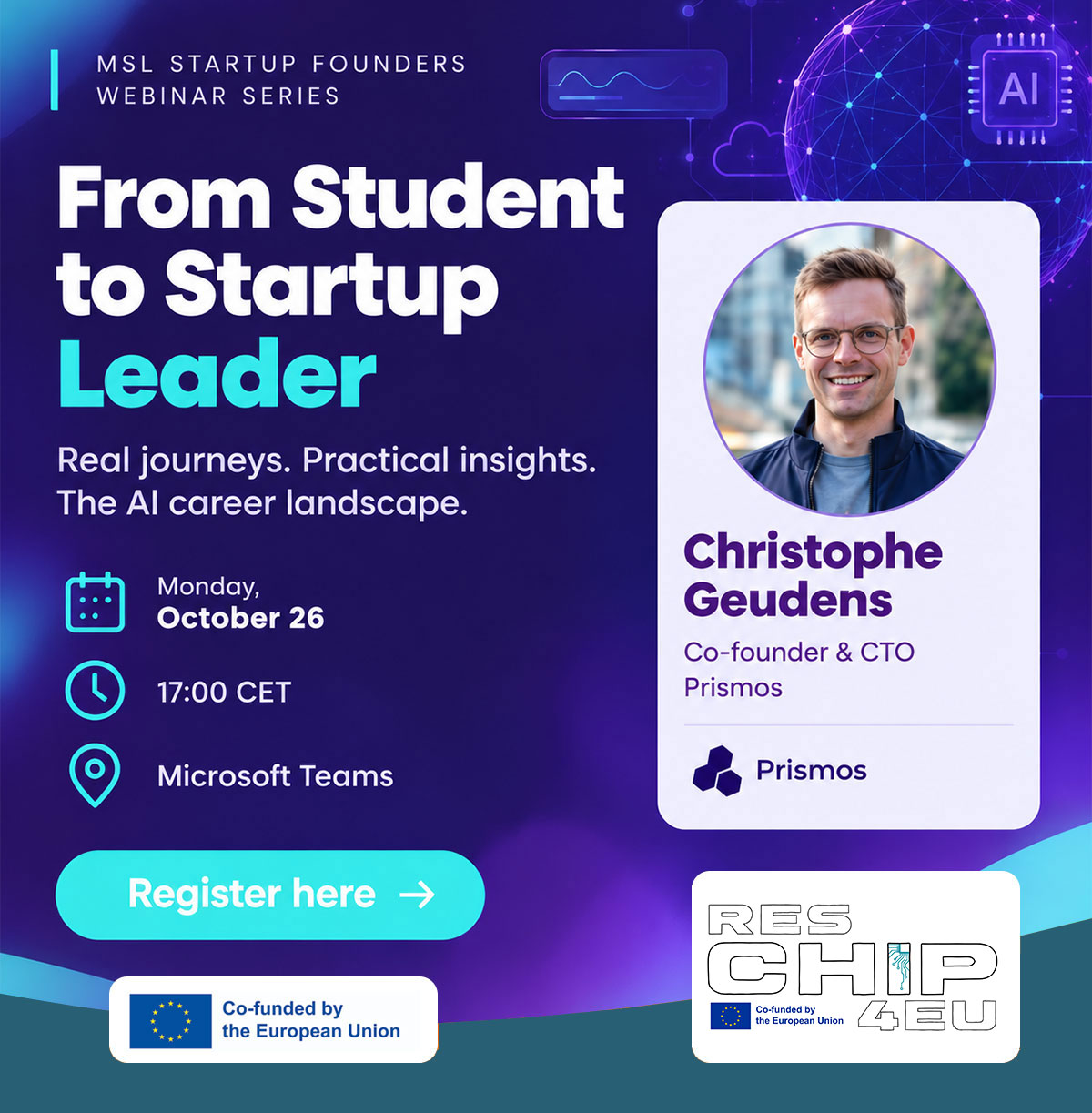
Inaugural Session: Christophe Geudens, Co-Founder & CTO of Prismos
The opening session features Christophe Geudens, Co-founder and Chief Technology Officer of Prismos, a Belgian startup developing software infrastructure for regulatory risk and public policy analysis.
Holding a PhD in Knowledge Representation from KU Leuven (2020) and bringing a strong background in NLP engineering, Christophe oversees data infrastructure and AI development at Prismos.
During this session, Christophe will discuss:
- From Student to Startup CTO: How he navigated the path from academic research to founding an AI venture.
- The AI Landscape from Within: Where genuine commercial opportunities lie and which technical competencies matter most in practice.
- Lessons from the Field: Practical insights into building early-stage architectures and overcoming development hurdles.
- Live Interactive Q&A: An open forum where students can ask direct questions about entrepreneurship, hiring, and technology careers.
The webinar will be introduced and hosted by Vilma Djala (28DIGITA).
Why This Matters for RESCHIP4EU Students
The RESCHIP4EU – Reinforcing Skills in Chips Design for Europe programme strengthens European education in microelectronics, System-on-Chip (SoC) design, and semiconductor technologies.
While AI is often perceived as pure software, modern AI systems are fundamentally limited by hardware constraints:
- Hardware-Software Co-Design: Advanced AI algorithms demand specialised, energy-efficient silicon, edge accelerators, and dedicated processors. Understanding how software platforms scale helps hardware designers build chips tailored to real-world computational bottlenecks.
- Entrepreneurship in Deep Tech: Complex semiconductor and computing challenges increasingly require startup-led innovation. Seeing how founders turn research into products encourages engineering students to consider venture creation.
- Connecting European Innovation: Linking hardware education with software ecosystems ensures Europe’s future semiconductor specialists can build and scale competitive technology enterprises.
Event Details & Registration
- 📅 Date: Monday, 26 October
- ⏰ Time: 17:00 CET
- 📍 Location: Microsoft Teams
- 👉 Register here: https://events.teams.microsoft.com/event/80d5362d-8843-41b4-ac25-6180466dae95@7c3574d4-f2c2-4447-bd77-d3c3cc68be6e
Official Website of the EU-Co-Funded Project RESCHIP4EU: https://28digital.eu/eu-collaborations/reschip4eu
Consortium Partners:
- 28 Digital (28DGTL)
- University of Bologna (UNIBO)
- Budapest University of Technology and Economics (BME)
- ISEN Méditerranée (ISEN)
- Polytechnic University of Milan (POLIMI)
- Polytechnic University of Turin (POLITO)
- Tallinn University of Technology (TALTECH)
- The University of Tampere Foundation (TAU)
- University of Turku (UTU)
- University of Trento (UNITN)
- SEMI Europe GmbH (SEMI)
- Evolutionary Archetypes Consulting SL (EAC)
- Junior Achievement Europe (JA EUROPE)
- STMicroelectronics ST (ST-I)
Funding Agency: European Health and Digital Executive Agency (HaDEA)
Project Number: 101158828 — RESCHIP4EU — DIGITAL-2023-SKILLS-04
Disclaimer: Co-Funded by the European Union. Views and opinions expressed are however those of the author(s) only and do not necessarily reflect those of the European Union or HADEA. Neither the European Union nor the granting authority can be held responsible for them.