Beyond the Fabs: Powering Europe’s Semiconductor Future Through Talent and Skills
Europe’s ambition to secure 20% of the global semiconductor market by 2030 has triggered unprecedented capital momentum. State-of-the-art fabrication plants, supply-chain localisation, and substantial public subsidies headline the European Union’s strategy. Yet the physical construction of advanced foundries addresses only one side of the equation.
Foundries and design labs require highly specialised human capital. Without thousands of engineers proficient in chip design, microelectronics, semiconductor physics, and advanced packaging, cutting-edge facilities risk sitting idle.
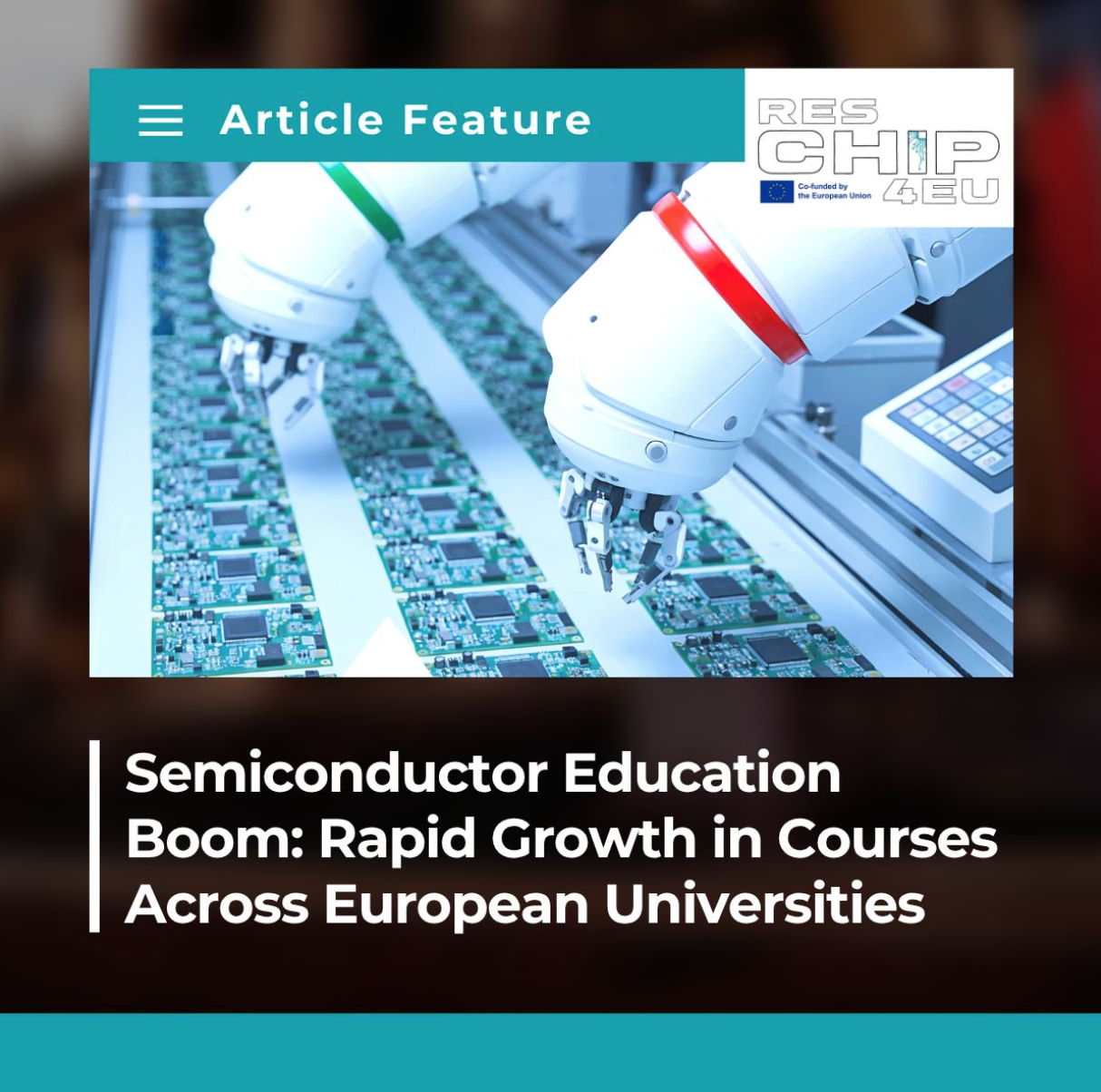
A recent analysis highlighted by RESCHIP4EU – Reinforcing Skills in Chips Design for Europe demonstrates that European academia is racing to meet this demand, revealing rapid growth in specialised study pathways across the continent.
The Exponential Rise of Microelectronics Education in Europe
Student interest and university offerings in semiconductor technologies have accelerated sharply over the past half-decade:
- Surging Global Demand: Global search interest and student applications for semiconductor-related academic programmes nearly doubled between 2019 and 2025.
- Rapid Curriculum Expansion: In Germany, the number of dedicated university programmes grew from 18 in 2019 to 38 in 2026. Italy more than tripled its number of programmes, from 6 to 21, while Sweden grew from 5 to 18.
- Policy Alignment: Backed by more than €43B in public investment under the European Chips Act investment framework, talent cultivation and workforce upskilling have officially become top-tier pillars of European industrial resilience.
The Bottlenecks Facing Higher Education
Despite this growth, individual universities face steep systemic obstacles when attempting to scale microelectronics curricula independently:
- High Infrastructure and Laboratory Costs: Establishing and maintaining semiconductor fabrication training labs, cleanrooms, and commercial electronic design automation (EDA) software licences requires capital investments few standalone departments can shoulder.
- Specialised Shortages of Academic Staff: Academic institutions routinely compete with private industry for top-tier microelectronics researchers and experienced lecturers and teaching staff.
- Interdisciplinary Skill Demands: Contemporary chip design no longer operates in an isolated electrical engineering silo. Modern engineers must master the intersections of hardware architecture, artificial intelligence acceleration, quantum devices, hardware-level cybersecurity, and circular, energy-efficient manufacturing.
How RESCHIP4EU Bridges the Talent Gap
To overcome these structural hurdles, RESCHIP4EU – Reinforcing Skills in Chips Design for Europe pools the infrastructure, teaching capacity, and industrial networks of leading universities and innovation partners across Europe.
Supported through 28DIGITAL and Evolutionary Archetypes Consulting SL, the initiative provides structured, pan-European pathways into advanced microelectronics:
- Two-Year Master in Intelligent Chips and Systems: A mobility-based degree where students study in two distinct European countries, graduating with a double master’s degree, practical entrepreneurship competencies, and direct industry mentorship.
- Open-Access Specialised E-Learning: Summer schools, modular technical certifications, and free online courses extend foundational and advanced semiconductor education to students, technicians, and working engineers across Europe.
By turning national educational efforts into a cohesive, collaborative European talent ecosystem, RESCHIP4EU – Reinforcing Skills in Chips Design for Europe ensures that Europe’s technological sovereignty is powered by the talent to design, build, and lead.
Source: Semiconductor Education Boom: Rapid Growth in Courses Across European Universities: https://www.academicjobs.com/en-eu/higher-education-news/semiconductor-education-boom-in-europe-university-courses-surge-7111
Official Website of the EU-Co-Funded Project RESCHIP4EU: https://28digital.eu/eu-collaborations/reschip4eu
Access the e-Learning Platform: https://28digital.ea.education/reschip4eu/
Consortium Partners:
- 28 Digital (28DGTL)
- University of Bologna (UNIBO)
- Budapest University of Technology and Economics (BME)
- ISEN Méditerranée (ISEN)
- Polytechnic University of Milan (POLIMI)
- Polytechnic University of Turin (POLITO)
- Tallinn University of Technology (TALTECH)
- The University of Tampere Foundation (TAU)
- University of Turku (UTU)
- University of Trento (UNITN)
- SEMI Europe GmbH (SEMI)
- Evolutionary Archetypes Consulting SL (EAC)
- Junior Achievement Europe (JA EUROPE)
- STMicroelectronics ST (ST-I)
Funding Agency: European Health and Digital Executive Agency (HaDEA)
Project Number: 101158828 — RESCHIP4EU — DIGITAL-2023-SKILLS-04
Disclaimer: Co-Funded by the European Union. Views and opinions expressed are however those of the author(s) only and do not necessarily reflect those of the European Union or HADEA. Neither the European Union nor the granting authority can be held responsible for them.