Looking Beyond What We See
When we think about environmental change, we often picture forests, rivers, coastlines, or agricultural landscapes. But how do scientists actually observe these changes over time, especially across entire countries or continents?
Environmental Monitoring
Environmental monitoring relies on information collected from many different sources. Soil samples provide valuable insights into local conditions, weather forecasts help us understand atmospheric processes, and population surveys can reveal how people interact with the environment.
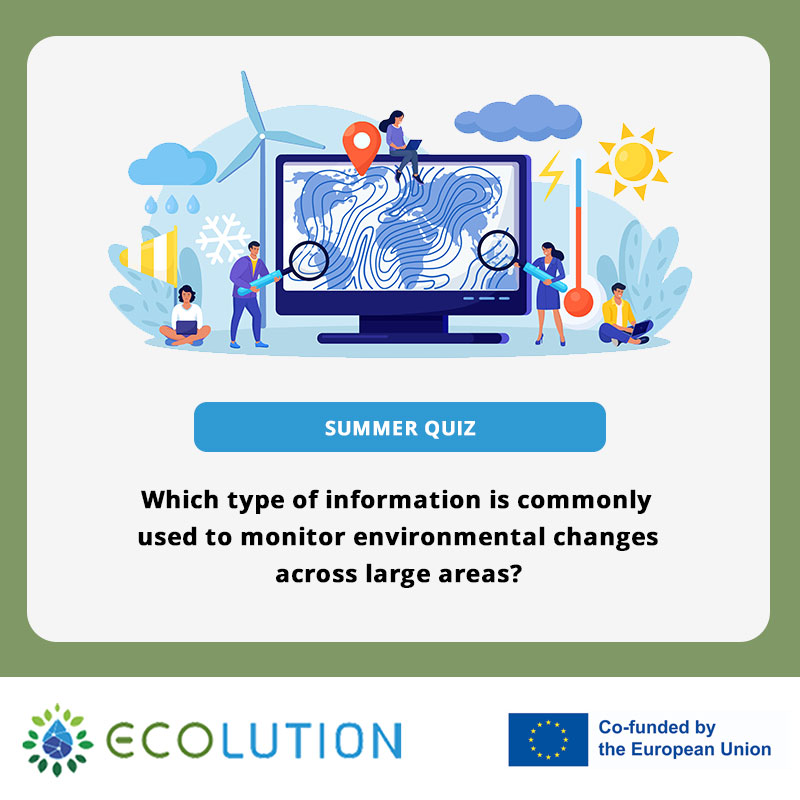
However, when the goal is to monitor environmental changes across large areas, another source of information becomes particularly important: satellite imagery.
Understanding which types of data are best suited to different environmental challenges is becoming an increasingly valuable skill for future environmental professionals.
That is the idea behind this week’s ECOLUTION Project Quiz, which invites participants to explore one of the technologies that supports modern environmental monitoring.
Why Satellite Imagery Matters
Satellites continuously observe the Earth’s surface, providing information that would be difficult, or even impossible, to collect solely through fieldwork.
They allow scientists and environmental professionals to monitor changes over time, identify long-term trends, and compare environmental conditions across extensive geographical areas.
Satellite imagery supports work in many different fields, including:
- Land use and land cover monitoring
- Forest and vegetation observation
- Water resource management
- Agricultural monitoring
- Disaster assessment
- Environmental planning
Because satellite observations can be collected repeatedly over the same locations, they provide a valuable way to understand how landscapes evolve and respond to natural processes and human activities.
Rather than replacing field measurements, satellite data complements other environmental information, creating a broader picture that supports research, planning, and decision-making.
From Data to Environmental Knowledge
Professionals also need to organise, analyse, interpret, and communicate the information they receive. Combining different datasets allows environmental challenges to be understood from multiple perspectives and supports more informed decisions.
This growing reliance on digital information means that environmental science increasingly overlaps with fields such as geographic information systems (GIS), remote sensing, spatial analysis, and environmental informatics.
These technologies help transform large volumes of environmental observations into practical knowledge that can support environmental protection, sustainable resource management, and long-term planning.
Learning Through the ECOLUTION MSc
These topics are explored within the Geospatial Data Sciences – Environmental Informatics (2W2) course in the ECOLUTION Project.
The course introduces students to the role of geospatial technologies and environmental data in understanding environmental systems. By working with spatial information and digital tools, students gain practical knowledge that supports environmental analysis, monitoring, and evidence-based decision-making.
As environmental sustainability increasingly relies on digital technologies, developing these skills helps prepare graduates for careers where environmental expertise and data-driven approaches go hand in hand.
Test Your Knowledge
The ECOLUTION MSc quiz offers a simple question with an important message: different environmental challenges require different sources of information, and understanding which tools are appropriate is part of becoming an environmental professional.
Whether you already work with environmental data or are simply curious about the technologies that help us understand our changing world, the quiz is an opportunity to learn something new and explore one of the many topics covered within the ECOLUTION MSc.
Funding Agency: EACEA – European Education and Culture Executive Agency
Learn more about ECOLUTION: https://www.ecolutionmsc.eu/
101140050 — ECOLUTION — ERASMUS-EDU-2023-PI-ALL-INNO
Disclaimer: Funded by the European Union. Views and opinions expressed are however those of the author(s) only and do not necessarily reflect those of the European Union or the European Education and Culture Executive Agency (EACEA). Neither the European Union nor EACEA can be held responsible for them.