Scaling Social Innovation: Grounding the MOVEᴱ Index in Real-World Experiences
Data frameworks and predictive models are only as powerful as the human experiences behind them. To build a future of work that leaves no one behind, we must bridge the gap between high-level technological design and the lived realities of the people who will actually use these tools.
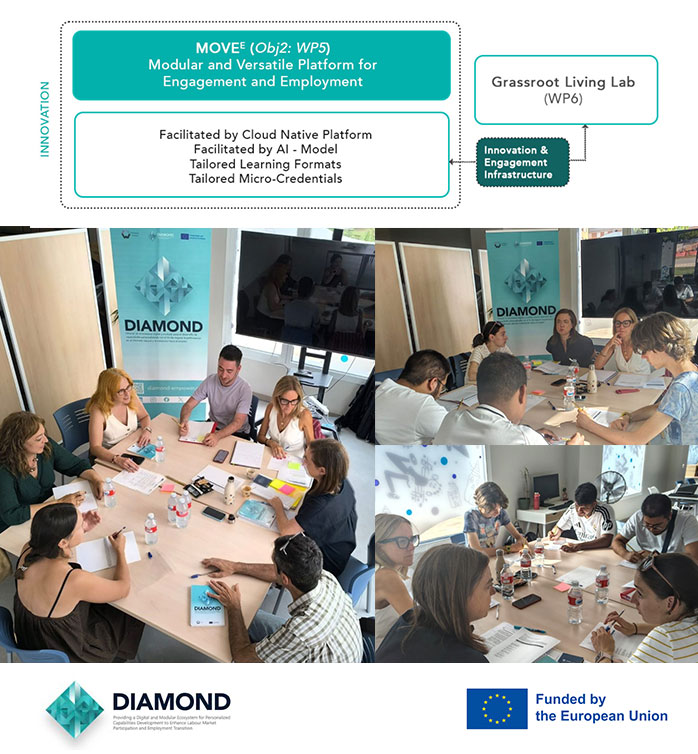
That is exactly the mission behind our latest milestone. On July 9th, Fundación Miradas, with the vital support of team members from the Universidad de Burgos (UBU), took a decisive step forward with the launch of our newest Grassroot Living Lab. This participatory, co-creative sandbox functions as a real-world testing environment where diverse stakeholders can collaborate to design, evaluate, and directly improve training processes based on authentic community needs.
These initial sessions successfully brought together professionals working in employment integration and disability advocacy, as well as active participants currently enrolled in the digital skills course. The direct experiences and contributions shared by these groups will be essential in adapting and optimising the tools developed throughout the project.
Looking Ahead
Moving forward, the project will continue to roll out and conduct these collaborative workshops across our wider network of partner grassroots organisations.
This ongoing on-the-ground testing serves as a vital component for the MOVEᴱ Index. The MOVEᴱ Index functions as an interactive framework designed to track personalised progress, map digital competencies, and recognise person-centred growth, ensuring that the project’s final tools are perfectly aligned with the practical needs of adult learners and integration professionals alike.
Funding Agency: European Research Executive Agency (REA)
Learn more about DIAMOND: https://diamond-empower.eu/
Project: 101178081 — DIAMOND — HORIZON-CL2-2024-TRANSFORMATIONS-01
Disclaimer: Funded by the European Union.
Views and opinions expressed are however those of the author(s) only and do not necessarily reflect those of the European Union or the European Research Executive Agency (REA).
Neither the European Union nor the granting authority can be held responsible for them.