ECOLUTION: Why Artistic Freedom Matters for Climate Action (Poll)
Addressing systemic environmental challenges requires more than scientific models, emissions metrics, and regulatory mandates. While evidence and legal frameworks define the scope of the ecological crisis, they rarely move communities to act on their own.
Transforming data into sustained civic engagement demands the power of independent, creative, and critical thinking to challenge underlying assumptions, expose institutional blind spots, and envision viable alternatives.
Within the ECOLUTION Project initiative, our international consortium brings together European partners, connecting research and practice across Europe to explore how cross-disciplinary learning bridges environmental governance, green technology, and human behaviour.
Our latest community poll focuses on a critical yet often overlooked dimension of sustainability: the role of artistic and critical thinking in advancing environmental solutions and policy.
The Gap Between Bureaucracy and Human Engagement
Environmental policy often struggles to connect with the wider public because it defaults to institutional language. Complex environmental impact assessments and technical spreadsheets provide essential evidence, but they frequently fail to convey human stakes.
This is where uncompromised creative expression becomes indispensable:
- Breaking Through Bureaucratic Silence: Independent creators are not bound by institutional diplomacy. They have the leeway to pose uncomfortable questions, challenge prevailing industry narratives, and expose contradictions that standard policy reports overlook.
- Grounding Data in Human Experience: Translating scientific projections into visual arts, narrative media, and participatory storytelling gives abstract climate targets an immediate emotional and civic reality.
- Prototyping Future Realities: Beyond critiquing current failures, creative freedom allows practitioners to imagine radically different models of urban living, resource sharing, and regenerative community design.
How Creative Thinking Can Be Applied In Practice
Research is already demonstrating how this can work in practice. A 2023 systematic review published in Futures examined participatory approaches to imagining sustainable urban futures. The researchers found that future-oriented sustainability work can go beyond technical modelling by bringing together governments, researchers, industry, and citizens through methods such as collaborative visioning, storytelling, visualisation, speculative design, and other creative approaches. These methods can help participants question existing assumptions, explore different perspectives, and imagine alternatives that may not emerge through conventional forecasting alone.
Learn more: https://www.sciencedirect.com/science/article/pii/S0016328723001726
Four Ways Artistic Freedom Can Drive Environmental Solutions
Our community poll invites educators, environmental practitioners, citizens, and ECOLUTION students to identify where creative independence makes the most tangible impact:
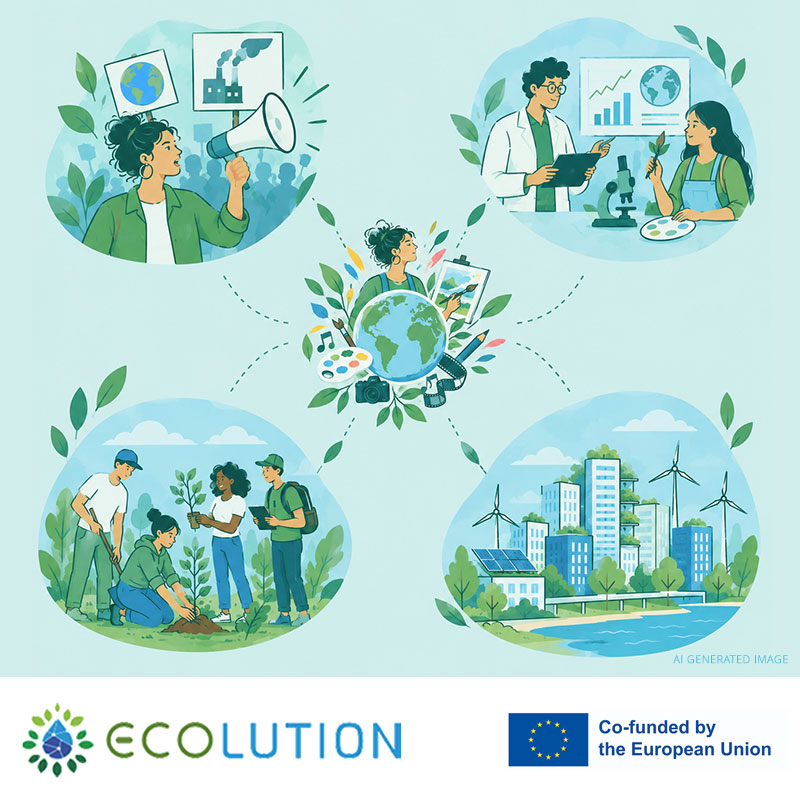
1. Unfiltered Climate Critique
Holding governing bodies and commercial industries accountable through investigative art, storytelling, visualisation, and critical thinking that challenge short-term political thinking.
2. Translating Complex Science
Converting dense climate models and ecological data into accessible visual narratives, interactive media, and community-centred stories that demystify environmental research.
3. Inspiring Local Civic Action
Mobilising grassroots groups and municipal communities around practical conservation, urban greening, and circular economy efforts through participatory creative projects.
4. Envisioning Future Sustainable Cities
Designing speculative architectural concepts, eco-conscious public spaces, and circular community models that make sustainable post-carbon living tangible and desirable.
Integrating Creative Perspectives into Green Education
Equipping the next generation of environmental leaders requires breaking traditional academic boundaries. By integrating creative inquiry, critical communication, and cross-disciplinary thinking alongside technical curricula, ECOLUTION Project prepares students to communicate environmental challenges clearly and design solutions that resonate with diverse communities.
Explore ECOLUTION Project Resources
- Access Free Course Modules & Toolkits: ecolution.ea.consulting/
- Learn More About the Master’s Programme: www.ecolutionmsc.eu/
- Join the Debate: Participate in the active community poll across our project social media channels: LinkedIn, X, and Instagram.
Official Website of the Erasmus+ Project ECOLUTION: https://www.ecolutionmsc.eu/
Consortium Partners:
- Ceska Zemedelska Univerzita V Praze
- Diethnes Panepistimio Ellados (IHU)
- Aarhus Universitet
- Asociacion Centro Tecnologico Naval Y Del Mar (CTN)
- Cerca Trova (CT)
- ECQA GmbH (ECQA)
- Evolutionary Archetypes Consulting SL (EAC)
- Ellino-Italiko Epimelitirio Athinas (GR-IT Chamber)
- AgriWatch BV
- DELTA-MPIS (DMPI)
- New Generation Sensors Srl (NGS)
- AquaBioTech Ltd (ABT)
- Politeknika Txorierri
Funding Agency: EACEA – European Education and Culture Executive Agency
101140050 — ECOLUTION — ERASMUS-EDU-2023-PI-ALL-INNO
Disclaimer: Funded by the European Union. Views and opinions expressed are however those of the author(s) only and do not necessarily reflect those of the European Union or the European Education and Culture Executive Agency (EACEA). Neither the European Union nor EACEA can be held responsible for them.