Creative Horizons: The DEXTER and Space Architecture
Designing habitats for extreme environments cannot be solved in isolation. It requires input from engineering, materials science, human psychology, and design. The DEXTER project was founded on this idea: innovation in space architecture requires experts from different fields working together.
As we launch our first module, Course 1: Creative Horizons, we want to highlight the curriculum and the European partnership that built it.
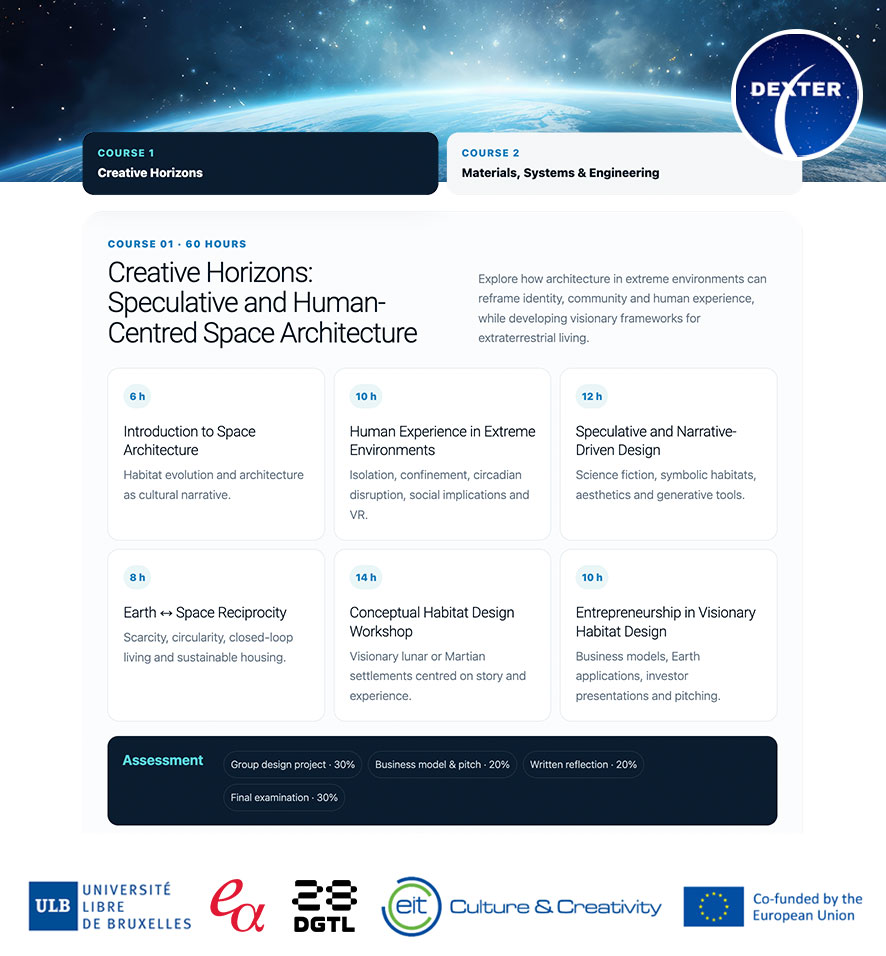
Course 1: Creative Horizons – Speculative and Human-Centred Space Architecture
The first half of the DEXTER Master Class is a 60-hour course focusing on speculative and human-centred space architecture. It asks students to look at how extreme environments can change identity, community, and human experience. From virtual reality and cultural narratives to closed-loop living and entrepreneurship, “Creative Horizons” sets the framework for extraterrestrial living. These strategies are also relevant for resilient housing, off-grid infrastructure, and emergency response in vulnerable environments on Earth.
The course includes the following lessons:
- Introduction to Space Architecture (6 hours): Explore the evolution of space habitats and discover how architecture reflects cultural identity, human values, and collective experiences.
- Human Experience in Extreme Environments (10 hours): Examine the psychological and social challenges of living in space, including isolation, confinement, disrupted circadian rhythms, and the role of virtual reality (VR) in understanding human needs.
- Speculative and Narrative-Driven Design (12 hours): Discover how science fiction, symbolism, aesthetics, and generative design tools can inspire imaginative approaches to extraterrestrial habitats.
- Earth ↔ Space Reciprocity (8 hours): Investigate how resource scarcity, circular systems, and closed-loop living in space can inform sustainable housing and resilient infrastructure on Earth.
- Conceptual Habitat Design Workshop (14 hours): Apply creative and human-centred design principles to develop visionary concepts for lunar or Martian settlements, focusing on storytelling and the experiences of future inhabitants.
- Entrepreneurship in Visionary Habitat Design (10 hours): Explore how innovative space architecture concepts can become viable solutions through business models, terrestrial applications, investor presentations, and pitching strategies.
Complementary Strengths for a Common Goal
Besides the amazing courses, one of the strengths of the DEXTER project is how the consortium partners complement each other. CREST provides the academic knowledge, Evolutionary Archetypes Consulting SL drives the strategy to share it, and 28DIGITAL (28DGTL) provides the technological infrastructure to host it. Together, we are teaching space architecture and building a resilient ecosystem that prepares students for the future of aerospace, sustainable construction, and human-centred design.
Discover the learning journey and enrol in Course 1 today via the DEXTER e-Learning Platform: https://28digital.ea.education/dexter-2/
Official Website of the EU-Co-Funded Project DEXTER: https://crest.ulb.be/dexter/
Consortium Partners:
- Université Libre de Bruxelles (ULB)
- Evolutionary Archetypes Consulting SL (EAC)
- 28DIGITAL (28DGTL)
European institutions & programs:
- Funding Agency: European Institute of Innovation and Technology (EIT)
- Programme: EIT Culture & Creativity
e-Learning Platform (in case the post is about online classes): https://28digital.ea.education/dexter/
Project KAVA Code: 062600033
Co-funded by the European Union. Views and opinions expressed are however those of the
author(s) only and do not necessarily reflect those of the European Union or the EIT. Neither the European Union nor the granting authority can be held responsible for them.
EIT Culture & Creativity is supported by the European Institute of Innovation and Technology (EIT), a body of the European Union.