Every online service depends on physical infrastructure. Cloud platforms, High-Performance Computing (HPC) systems, artificial intelligence applications, and the data centres supporting them all require computing resources and energy to operate.
As demand for these technologies continues to grow, an important question follows: How can ICT infrastructure expand while limiting its environmental footprint?
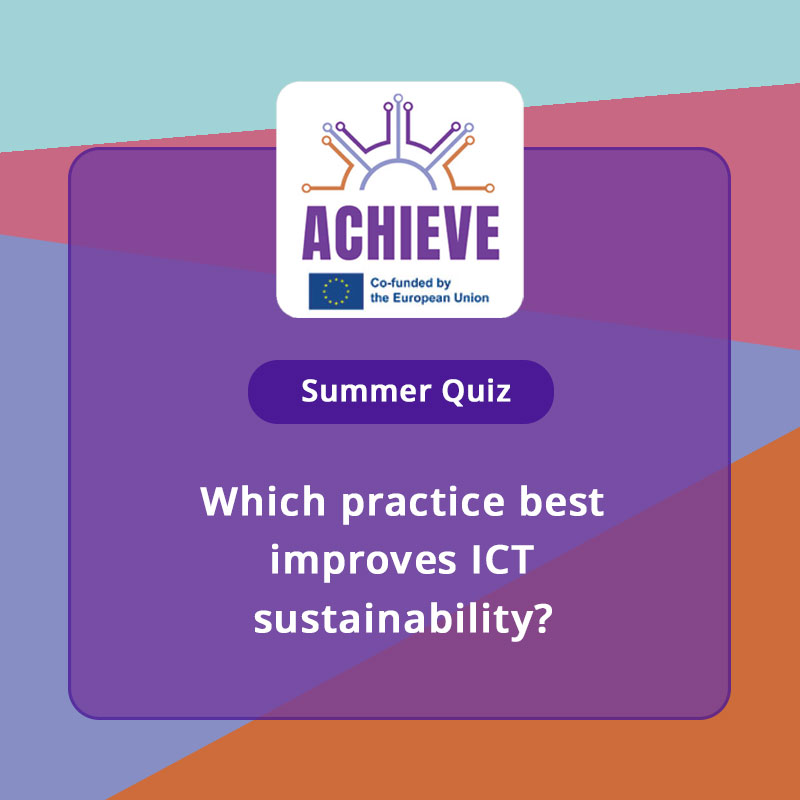
This is the focus of the latest Summer Quiz from ACHIEVE, which asks participants to identify the practice that can best improve ICT sustainability.
The options include running hardware at full power, replacing hardware every year, duplicating all data, and using virtualisation and efficiency. The correct answer is virtualisation and efficiency.
Why Virtualisation Matters
Virtualisation allows multiple virtual computing environments to share the resources of the same physical hardware. Instead of requiring a separate physical machine for every workload, computing resources can be allocated according to demand and used more efficiently.
This can help improve hardware utilisation and reduce the amount of physical infrastructure required to deliver computing services. Efficient management of computing resources can therefore play an important role in reducing unnecessary energy and resource use.
The other options in the quiz illustrate why decisions about how ICT infrastructure is operated also matter. Running hardware at full power regardless of actual demand can waste energy, while unnecessarily frequent hardware replacement contributes to greater resource consumption and electronic waste. Duplicating data without a clear need also requires additional storage capacity and the infrastructure needed to maintain it.
Sustainability and the Growth of Advanced Computing
The question becomes increasingly relevant as advanced computing develops. AI applications can require significant computational resources, while HPC systems are designed to perform demanding calculations at very large scales. Cloud computing, meanwhile, supports a growing range of digital services used by individuals, businesses, researchers, and public organisations.
Supporting this growth requires more than simply adding computing capacity. Understanding how to design, manage, and use infrastructure efficiently is also becoming an important skill in the ICT sector.
This connection between advanced computing and the skills needed to manage modern infrastructure is central to ACHIEVE.
Developing Skills for Modern Computing Infrastructure
The Double Degree Master’s programme in “Cloud and Networking Infrastructure and HPC”, part of the EIT Digital Master School, offers students the opportunity to deepen their knowledge of cloud computing, networking infrastructure, and High-Performance Computing.
By looking at these areas together, students can build an understanding of the infrastructure behind modern digital services and the considerations involved in operating increasingly complex computing environments.
Within the project, Evolutionary Archetypes Consulting SL contributes to connecting education with employability and applied learning, while 28DIGITAL supports the programme within the broader European digital skills landscape.
The latest Summer Quiz offers a simple entry point into a much larger discussion by asking:
Which practice best improves ICT sustainability?
As computing needs continue to increase, making better use of the resources already available will remain an important part of building more sustainable ICT infrastructure:
The quiz series will continue to explore Cloud Computing, HPC, AI, and related topics, with answers and additional insights brought together in a special edition of the ACHIEVE Pulse newsletter.
Learn more about ACHIEVE: https://28digital.eu/eu-collaborations/achieve
101190015 — ACHIEVE — DIGITAL-2023-SKILLS-05
Disclaimer: Co-Funded by the European Union. Views and opinions expressed are however those of the author(s) only and do not necessarily reflect those of the European Union or HADEA. Neither the European Union nor the granting authority can be held responsible for them.