
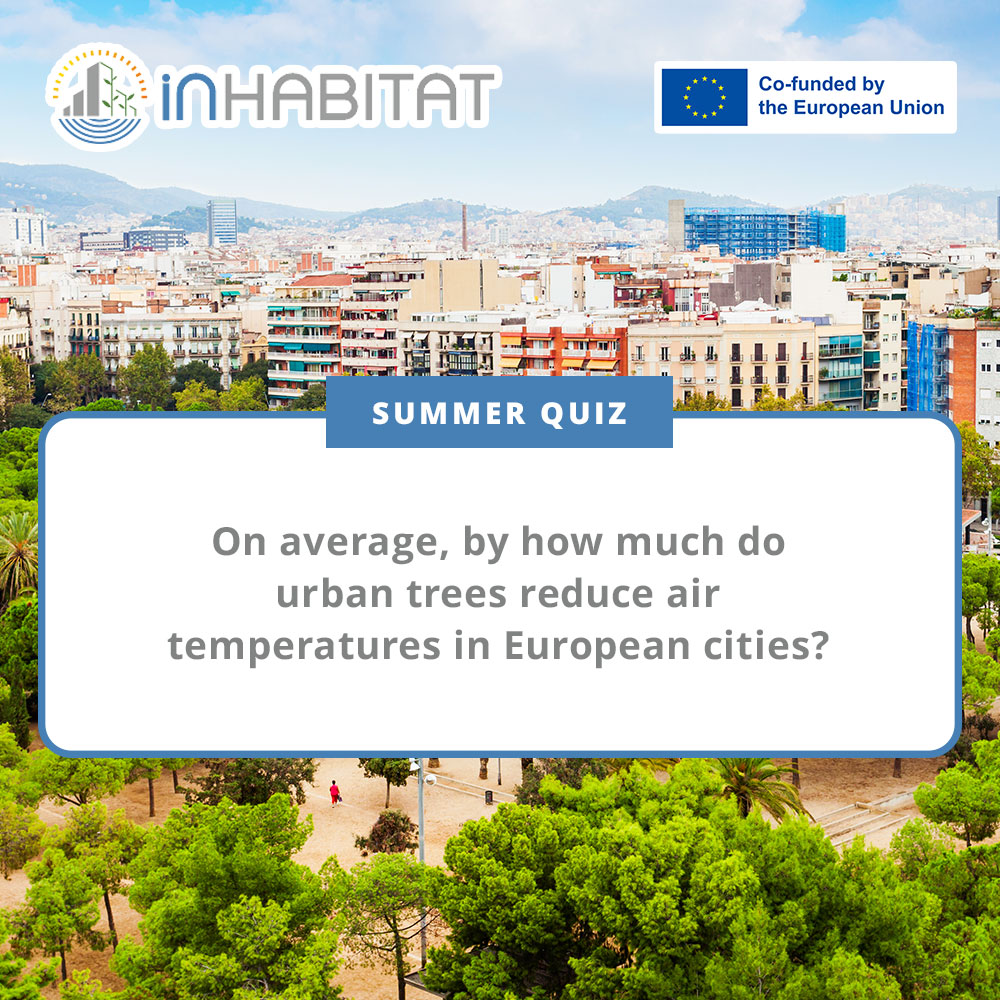
We all know the feeling of looking for the nearest patch of shade on a hot summer day. In cities, where buildings and paved surfaces can absorb and retain heat, a tree-lined street or green space can feel noticeably different.
But is that difference only about standing in the shade, or can urban trees actually influence temperatures across a city?
Research covering hundreds of European cities has investigated exactly that question, looking at the relationship between urban trees and air temperatures. The results show that trees can have a measurable cooling effect, but for now, we’re leaving the exact figure for you to guess in the INHABITAT Project poll on LinkedIn.
How Do Trees Cool Urban Environments?
According to the European Commission, trees act as natural cooling systems in more than one way.
The first is the most familiar: shade. Tree canopies block part of the incoming solar radiation, reducing direct exposure to the sun and helping prevent surfaces underneath them from heating as much as they otherwise would.
The second is evapotranspiration. Trees absorb water through their roots and release water vapour through their leaves. This process transfers heat from the surrounding environment and contributes to cooling the air.
This means the effect of urban trees extends beyond simply providing a comfortable place to stand on a hot afternoon. When vegetation is incorporated throughout urban areas, it can become part of how cities respond to periods of high temperatures.
Why Urban Greenery Matters During Extreme Heat
The European Commission highlights urban greening as one of the ways cities can adapt to increasingly severe heat. Trees are part of a broader range of green infrastructure that can contribute to reducing heat exposure and creating urban environments that are better prepared for high temperatures.
Their effectiveness also raises an important question for urban planning: where should green infrastructure be located to make the greatest difference?
The presence of vegetation, the characteristics of the surrounding built environment and the way urban spaces are designed all influence how people experience heat. Understanding these relationships can therefore help cities make more informed decisions about their public spaces and long-term development.
Connecting Urban Nature and INHABITAT MSc
These questions sit naturally within the wider themes explored through INHABITAT MSc, where students examine sustainable urban environments and the relationship between environmental conditions and the places in which people live.
Understanding urban heat requires looking at more than temperature alone. It also means considering vegetation, buildings, land use and the ways different elements of a city interact.
Urban trees offer a particularly tangible example. We can immediately feel the difference when we step underneath one on a hot summer day. The interesting question is how much of a difference trees can make beyond that individual patch of shade.
So, what would you guess?
Head over to the INHABITAT MSc poll and see how close you are.
Source: European Commission – 5 things you should know about extreme heat and how to beat it
Funding Agency: EACEA – European Education and Culture Executive Agency
Learn more about INHABITAT: https://www.inhabitatmsc.eu/
101108631 — INHABITAT — ERASMUS-EDU-2022-PI-ALL-INNO
Disclaimer: Funded by the European Union. Views and opinions expressed are however those of the author(s) only and do not necessarily reflect those of the European Union or the European Education and Culture Executive Agency (EACEA). Neither the European Union nor EACEA can be held responsible for them.