
Materials, Systems, and Engineering of Extraterrestrial Habitats: Inside DEXTER Course 2
Visionary concepts for living beyond Earth only work when they can survive real physical constraints. Vacuum, cosmic radiation, abrasive dust, and severe thermal swings leave zero margin for guesswork.
That is why the DEXTER project pairs speculative architectural thinking with rigorous technical validation. Course 2: Materials, Systems, and Engineering of Extraterrestrial Habitats explores the science of making off-Earth settlements feasible. It is designed for researchers, doctoral candidates, and engineers. Following Course 1: Creative Horizons, it forms the second 60-hour module of the 120-hour DEXTER Master Class.
Course 2: From Habitat Concepts to Technically Substantiated Settlements
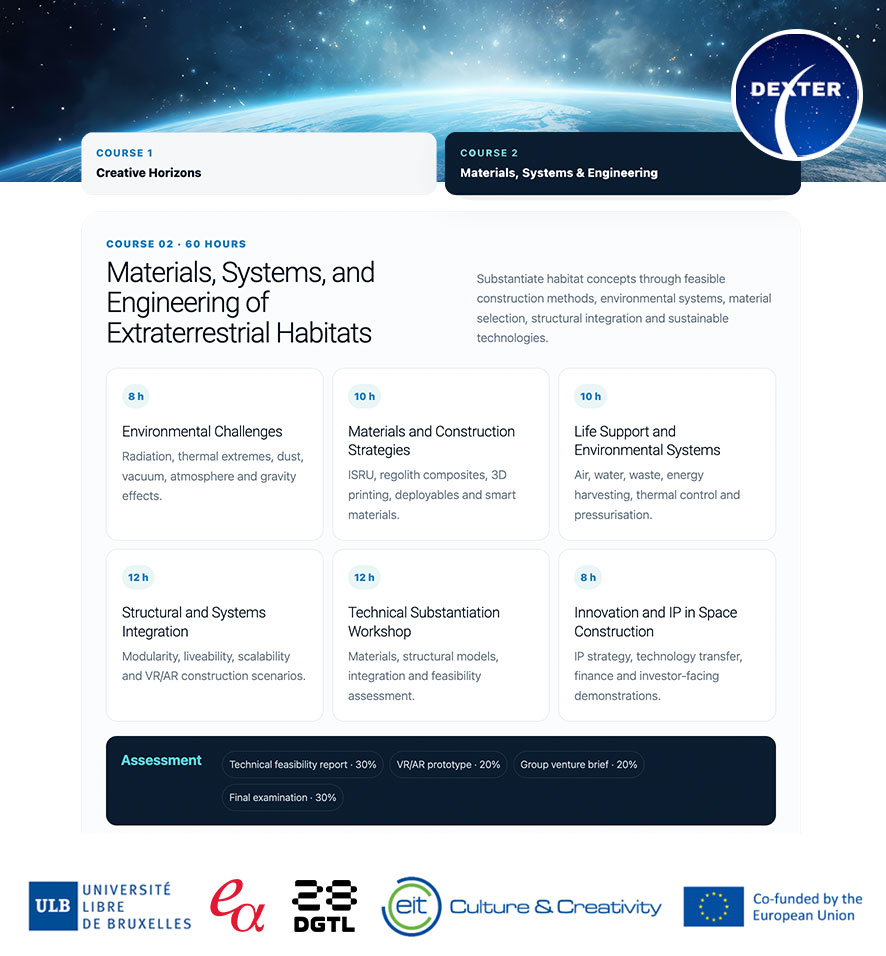
Course 2 spans 60 hours across six structured lessons:
- Environmental Challenges (8 hours): Examine the harsh realities of extraterrestrial environments. Topics include radiation, thermal extremes, lunar and Martian dust, vacuum conditions, atmospheric composition, and altered gravity effects.
- Materials and Construction Strategies (10 hours): Explore in-situ resource utilisation (ISRU) and regolith composites. Other topics include additive manufacturing, 3D printing, deployable structures, and multifunctional smart materials.
- Life Support and Environmental Systems (10 hours): Design closed-loop systems for extraterrestrial habitats. Topics include air revitalisation, water recovery, waste management, energy harvesting, thermal control, and cabin pressurisation.
- Structural and Systems Integration (12 hours): Address modularity, crew liveability, and long-term settlement scalability. Explore virtual and augmented reality (VR/AR) construction scenarios.
- Technical Substantiation Workshop (12 hours): Put theory into practice by building structural models and integrating subsystems.
- Innovation and IP in Space Construction (8 hours): Translate engineering breakthroughs into real-world value. Explore intellectual property strategy, technology transfer, finance, and investor-facing demonstrations.
The consortium developed this course under the academic leadership of Centre for Research and Engineering in Space Technologies (CREST) at Université Libre de Bruxelles (ULB).
Earth-Space Reciprocity and European Collaboration
Every engineering constraint solved for space has immediate relevance on Earth. These innovations include closed-loop water and waste recovery, renewable energy architectures, modular construction, and resource-efficient materials. On Earth, they support resilient housing, off-grid infrastructure, and emergency response in vulnerable regions.
Across all six lessons, the DEXTER consortium unites complementary European strengths: ULB and CREST anchor the curriculum in aerospace engineering and doctoral research. Evolutionary Archetypes Consulting SL (EAC) is responsible for the e-learning platform. 28DIGITAL connects the interactive online learning infrastructure and entrepreneurial translation to their ecosystem of students.
Explore the curriculum and access Course 2 on the DEXTER e-Learning Platform: https://28digital.ea.education/dexter-2/
Project KAVA Code: 062600033
Co-funded by the European Union. Views and opinions expressed are however those of the author(s) only and do not necessarily reflect those of the European Union or the EIT. Neither the European Union nor the granting authority can be held responsible for them.
EIT Culture & Creativity is supported by the European Institute of Innovation and Technology (EIT), a body of the European Union.