COP31 and Climate-Resilient Cities: Turning Policy into Urban Engineering
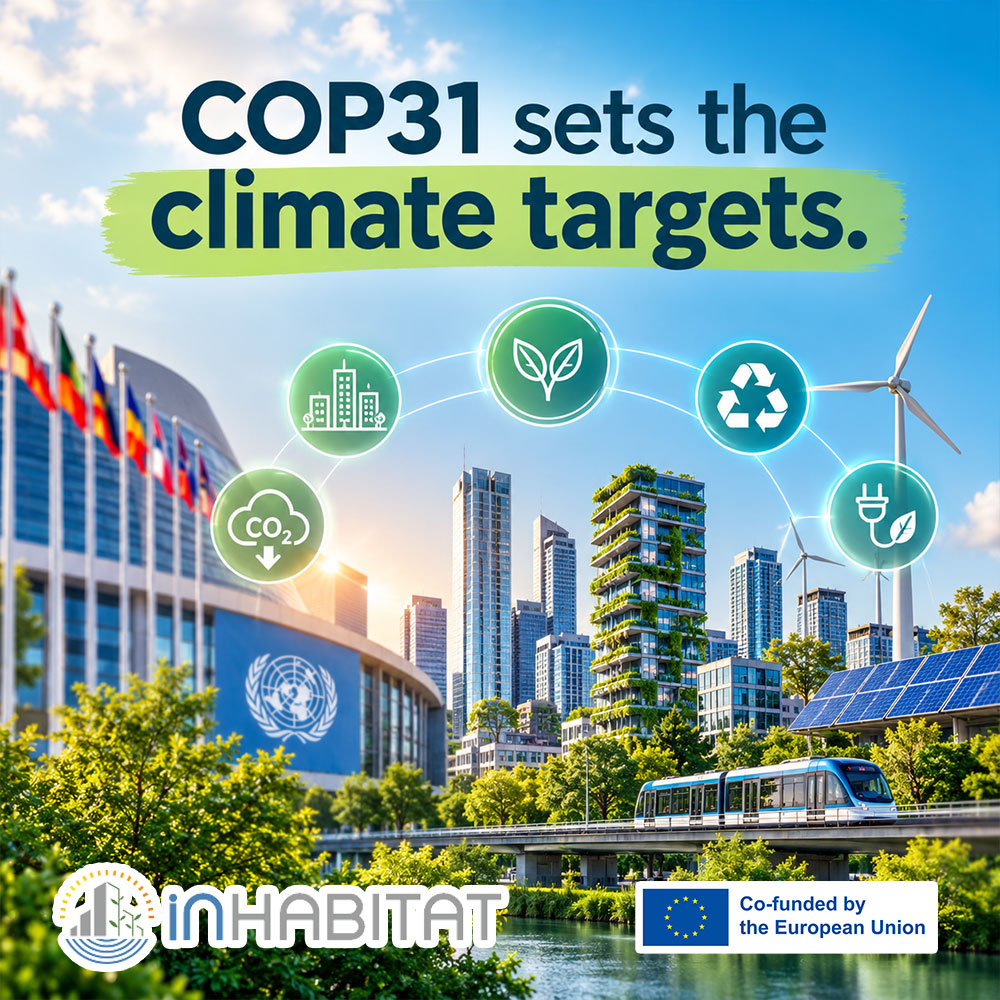
As global leaders gather for COP31, in November 2026, one message defines the climate agenda. National emission pledges only succeed if cities can deliver them on the ground.
Nearly 70% of the world’s population is projected to live in urban areas by 2050. As a result, cities face growing energy demand and climate vulnerability.
Meeting international climate goals requires more than policy declarations. It requires engineers and urban specialists capable of designing low-carbon buildings, integrating renewable energy grids, closing material and waste loops, and using real-time sensor data to manage urban infrastructure.
Bridging Climate Ambition and Engineering Practice
That is the core focus of the INHABITAT project, an Erasmus+ Knowledge Alliance developing an advanced, interactive, and certified 120-ECTS Master of Science programme on Smart Urban Sustainability.
Rather than treating environmental design, digital infrastructure, and business strategy as separate disciplines, INHABITAT combines them into an applied curriculum built around real urban climate challenges:
- Urban Sustainability & Climate-Resilient Built Environment (Courses: INH-A.1 & INH-A.2): Equips learners with life cycle assessment (LCA), green building standards, circular construction principles, and GIS-based environmental monitoring to reduce the carbon footprint of buildings and urban spaces.
- Waste Treatment & Energy Efficient Cities (Courses: INH-A.3 & INH-B.2): Covers solar, wind, bio-energy, intelligent transport systems, e-waste recovery, and advanced wastewater treatment aligned with circular economy targets.
- Smart Urban Data, IoT, and Geodata (Courses: INH-B.1, INH-C.1 & INH-C.2): Trains specialists to deploy environmental sensors, process Copernicus satellite and drone geodata, and secure smart city networks using modern data analytics and blockchain frameworks.
- Sustainable Business and Policy Frameworks (Courses: INH-B.3 & INH-C.3): Connects technical engineering with environmental law, green growth economics, and sustainable business model innovation.
Hands-On European Mobility for Graduates and Professionals
Designed for both bachelor’s graduates and working professionals with at least five years of relevant experience, the INHABITAT MSc pairs two years (four semesters) of remotely delivered lectures on the INHABITAT e-Learning Platform with direct field experience. Students complete two 15-day in-person experimental laboratory periods at Kauno Technologijos Universitetas (KTU) and Politecnico di Milano (POLIMI), followed by a 30-day industrial internship with partner enterprises in Paris, Milan, Sofia, or Bucharest.
By uniting four universities, one VET provider, seven high-tech ICT/IoT SMEs, and a certification body across 10 European countries, INHABITAT ensures that the engineers shaping Europe’s cities have the practical skills to turn COP31 commitments into lasting climate resilience.
Explore the curriculum on the INHABITAT e-Learning Platform: https://inhabitat.ea.consulting/
Sources:
- C40 Cities: Mayors representing more than a quarter of a billion people set out next year of climate actions as COP31 opens in Türkiye
- UNFCCC COP31 (official conference page for Antalya, 9–20 November 2026): https://unfccc.int/cop31
- Other Sources: UN: 68% of the world population projected to live in urban areas by 2050, says UN
Official Website of the Erasmus+ Project INHABITAT: https://www.inhabitatmsc.eu/
Consortium Partners:
- Diethnes Panepistimio Ellados (IHU)
- Politecnico di Milano (POLIMI)
- Kauno Technologijos Universitetas (KTU)
- Hochschule Rhein-Waal (HSRW)
- Cerca Trova (CT)
- Ventspils Tehnikums (VVS)
- ECQA GmbH (ECQA)
- Evolutionary Archetypes Consulting SL (EAC)
- SYSWIN Solutions Srl (SYS)
- Efesto (EF)
- InterConsult Bulgaria (ICB)
- Holonix Srl (HX)
Funding Agency: EACEA – European Education and Culture Executive Agency
101108631 – INHABITAT – ERASMUS-EDU-2022-PI-ALL-INNO
Disclaimer: Funded by the European Union. Views and opinions expressed are however those of the author(s) only and do not necessarily reflect those of the European Union or the European Education and Culture Executive Agency (EACEA). Neither the European Union nor EACEA can be held responsible for them.