How Evidence-Based Media Literacy and Participatory Storytelling Counter Disinformation
Kindness is often viewed as a gentle sentiment, yet standing up for mutual respect in polarised digital environments requires skill, critical awareness, and active engagement.
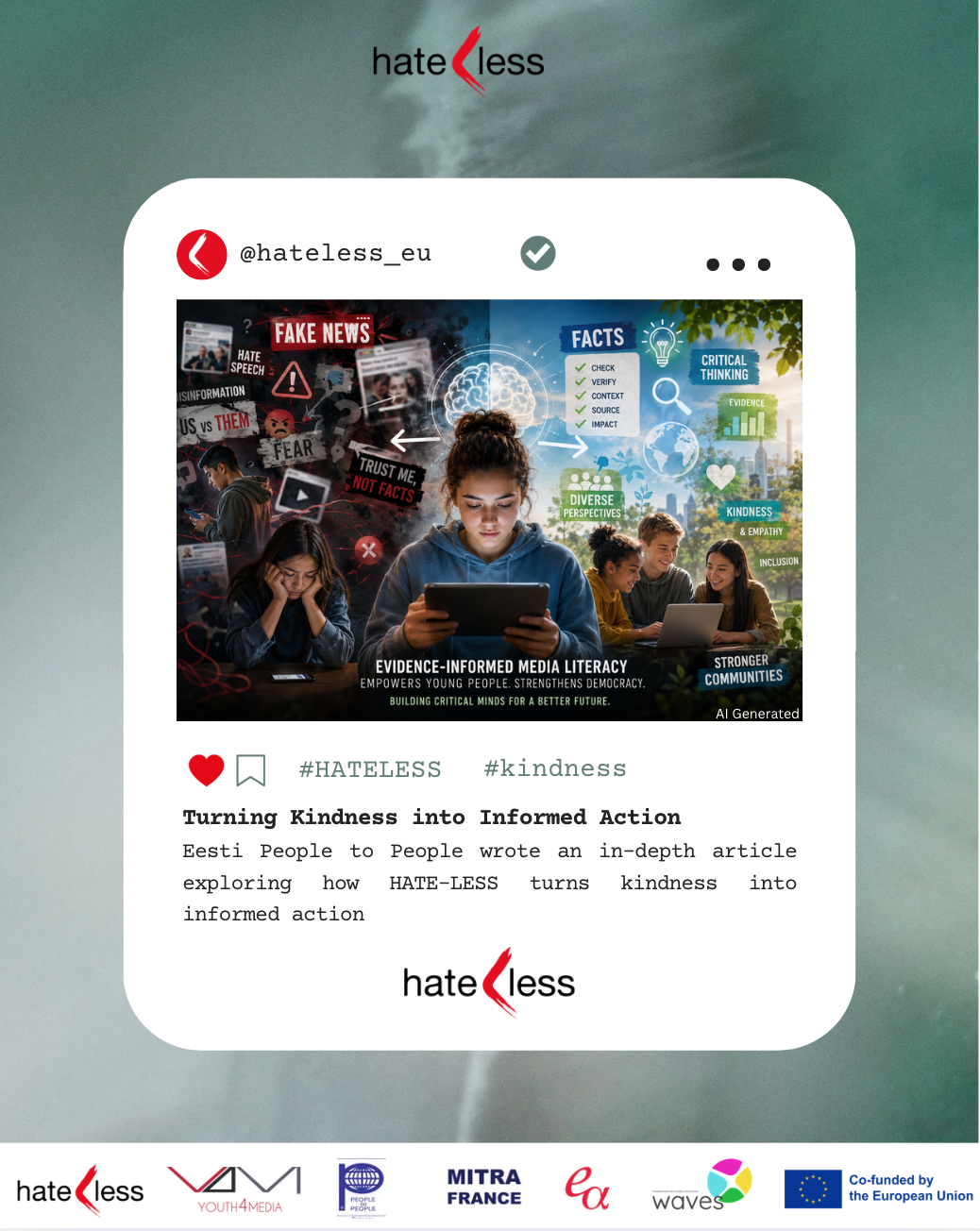
In the article HATE-LESS: Turning Kindness into Informed Action published by the global People to People International (PTPI) network, project partner Eesti People to People reflects on the foundational principles of the HATE-LESS project, examining how youth workers can help young people move from passive media consumption to constructive, evidence-based dialogue.
Understanding the Perception Gap in Digital Spaces
The article begins by highlighting the disparity between public perception and measurable reality. Drawing on data from the Eurobarometer survey on migrant integration, the article notes that respondents on average estimated the proportion of non-EU migrants in their countries at around 16%, whereas official Eurostat statistics recorded the actual figure at under 7%.
This difference is rarely the result of intentional deception by individuals. Rather, it reflects how selective media framing, cropped clips, and sensationalised algorithms shape everyday perceptions. When individuals are reduced to labels, authentic personal perspectives are excluded from public discussion.
Combining Prebunking with Intergroup Contact
To address this challenge, HATE-LESS combines modern cognitive science with proven non-formal educational practices:
- Inoculation and Prebunking: Research published in Science and Science Advances indicates that false narratives spread significantly faster than corrective facts. Inoculation theory prepares young people in advance by teaching them to recognise manipulation techniques before encountering them at full strength.
- Contact Hypothesis in the Digital Age: Drawing on Gordon Allport’s contact hypothesis, the project creates structured opportunities for young people to connect with individuals from diverse backgrounds and document their shared experiences through participatory video.
- Structured Storytelling Frameworks: Using non-formal models such as CARE (Curiosity, Attention, Reflection, Empower) and LOVE (Look, Open, Voice, Empower), participants learn to challenge harmful narratives without repeating hateful language.
Open-Access Resources for Youth Organisations
The article also highlights the concrete, freely accessible materials developed by the HATE-LESS project, including:
- Methodological Guidelines for Participatory Actions: A comprehensive framework rooted in Participatory Action Research.
- Multilingual Youth Worker Toolkit: Six practical modules covering media literacy, digital manipulation, and online dialogue, translated into seven European languages (English, Estonian, French, German, Greek, Spanish, and Ukrainian).
- Train the Trainer Handouts: Adaptable 4-part session plans covering spatial storytelling, marginalised voices, algorithmic influence, and counter-narrative production.
- Monitoring and Evaluation Repository: Fifteen quantitative and qualitative assessment tools to measure educational impact.
Read the full article: HATE-LESS: Turning Kindness into Informed Action
Access all resources for free: hate-less.eu/results
Funding Agency: JUGEND für Europa
Learn more about HATE-LESS: https://hate-less.eu
Project: 2024-1-DE04-KA220-YOU-000244181
Disclaimer: Co-financed by the European Union. The opinions and points of view expressed are solely those of the author(s) and do not necessarily reflect those of the European Union or of the JUGEND für Europa (German National Agency for Erasmus+ Youth, Erasmus+ Sport and the European Solidarity Corps).