What Happens to Rain After It Reaches the Ground?
As summer comes to an end and September begins, our latest ECOLUTION Project quiz turns to a process that plays an important role in the way water moves through our environment: surface runoff.
This week, we are asking:
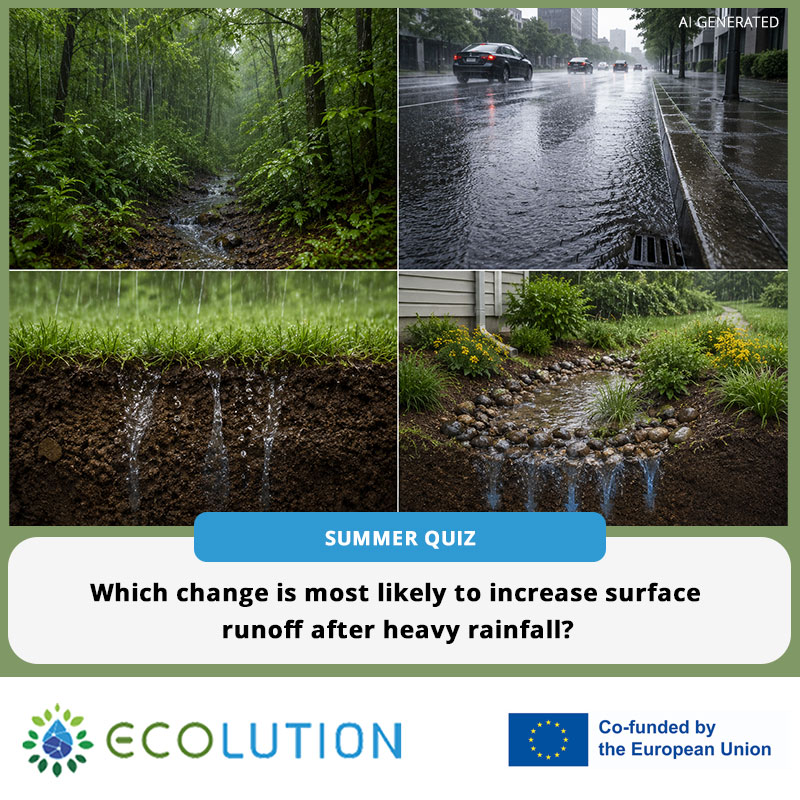
Which change is most likely to increase surface runoff after heavy rainfall?
The four possible answers are:
- More paved surfaces
- Denser vegetation
- More permeable soil
- Greater infiltration
Each option is connected to what happens when rain reaches the ground. Before we reveal the answer, let’s take a closer look at the processes behind the question.
What Is Surface Runoff?
Rain does not simply disappear when it reaches the ground. Depending on the conditions it encounters, water can follow several different pathways through the environment.
Some rainfall enters the soil, while some may be intercepted by vegetation. Water can also remain at or move across the land surface.
This movement of water across the ground is known as surface runoff (Source).
How much runoff occurs is influenced by several interacting factors. These can include the characteristics and condition of the soil, vegetation and land cover, the properties of the surface, and the intensity and duration of rainfall.
This means that understanding runoff involves looking not only at how much rain falls, but also at the environment it falls onto.
Following Water Through the Environment
The movement of rainfall is part of a much larger hydrological system.
Water continually moves between the atmosphere, land, rivers and other water bodies. Processes such as precipitation, infiltration, evaporation and runoff are interconnected, and changes in one part of the system can influence what happens elsewhere.
This is one reason hydrology is so important when studying environmental systems.
A rainfall event that looks relatively simple at first can involve a complex interaction between weather conditions, soil characteristics, vegetation, topography and land use. Understanding these interactions helps researchers examine how water behaves across different landscapes and under different conditions.
Why Does Runoff Matter?
Surface runoff is a natural part of the water cycle, but understanding how and why it occurs is important for a range of environmental questions.
The movement of water across a landscape can influence rivers and other water bodies, soil and sediment movement, water availability, and the transport of materials through the environment.
Runoff is also relevant when considering how different landscapes respond to periods of heavy rainfall.
For environmental professionals, the challenge is therefore not simply to observe that water is moving, but to understand the different processes and conditions influencing where it goes and how quickly it gets there.
Hydrology and the ECOLUTION Project
This week’s question connects with Hydrological and Climate Variability in the ECOLUTION Project.
Hydrology provides an important basis for understanding how water moves through natural systems and how those systems interact with changing environmental and climatic conditions.
The topic also demonstrates the interconnected nature of environmental sustainability. Water cannot be considered entirely separately from soil, vegetation, land use, weather or climate. Understanding environmental challenges often requires examining how these different elements interact.
This interdisciplinary perspective is also reflected across the ECOLUTION MSc, which brings environmental sustainability together with digital technologies and data-driven approaches to prepare students for the evolving smart environmental sustainability sector.
What Do You Think?
Now, return to the original question:
Which change is most likely to increase surface runoff after heavy rainfall?
Is it more paved surfaces, denser vegetation, more permeable soil, or greater infiltration?
Think about what happens to rainwater once it reaches the ground and which of these changes might affect its ability to move into or across the surface.
The correct answer will be revealed in our next ECOLUTION quiz update, where we’ll take a closer look at the science behind it and why it matters for environmental management.
Read more about the water cycle: https://ec.europa.eu/environment/stories/water-cycle/
Discover more environmental concepts on GEMET: https://www.eionet.europa.eu/gemet/en/concept/8225
Funding Agency: EACEA – European Education and Culture Executive Agency
Learn more about ECOLUTION: https://www.ecolutionmsc.eu/
101140050 — ECOLUTION — ERASMUS-EDU-2023-PI-ALL-INNO
Disclaimer: Funded by the European Union. Views and opinions expressed are however those of the author(s) only and do not necessarily reflect those of the European Union or the European Education and Culture Executive Agency (EACEA). Neither the European Union nor EACEA can be held responsible for them.