
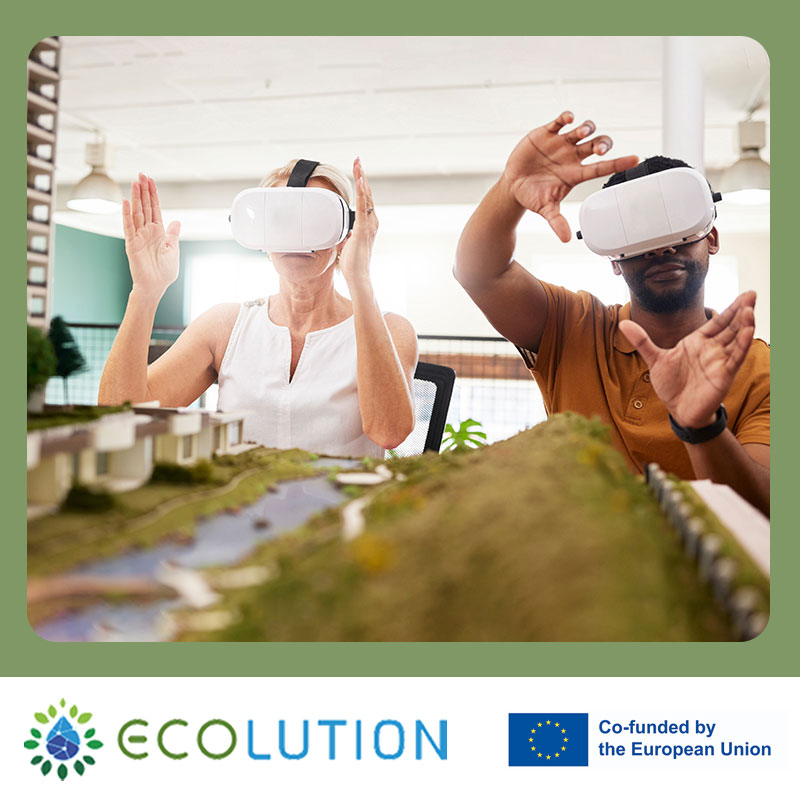
Extended reality (XR), which includes virtual reality (VR), augmented reality (AR), and mixed reality (MR), is used across a wide range of sectors, including training, education, and industrial processes. These technologies make it possible to simulate environments, visualize systems, and interact with digital representations of real-world conditions.
In environmental contexts, this has practical implications.
Environmental systems are often complex and difficult to observe directly. They may involve large geographic areas, long timeframes, or conditions that are not easily accessible. In some cases, testing real-world scenarios is either too costly or not feasible due to safety or environmental constraints.
XR technologies provide a way to work around these limitations.
By creating virtual or augmented environments, it becomes possible to explore how systems behave under different conditions. For example, users can examine how environmental factors interact, observe changes over time, or test different scenarios in a controlled setting. These environments can be adjusted and repeated, allowing for consistent analysis and comparison.
The European Commission highlights that XR applications are used across sectors such as training, education, and industrial processes.
Source: Extended reality
This reflects the broader role of XR as a tool for applied learning and simulation. In practice, it is used to support training, improve understanding of complex systems, and allow users to engage with environments that would otherwise be difficult to access.
In environmental management, these capabilities are particularly relevant.
Visualization plays an important role in understanding environmental systems. Being able to represent data and processes spatially can support interpretation and communication. XR tools can enhance this by allowing users to move through environments, interact with elements, and view systems from different perspectives.
Simulation is another key application. Environmental decisions often involve uncertainty, and the ability to test scenarios can support more informed approaches. XR environments allow users to explore potential outcomes without affecting real-world systems. This is especially useful in contexts such as planning, risk assessment, and training.
Training itself is an important area of application. XR can be used to create controlled environments where users can develop skills and test decisions without real-world consequences. This is particularly relevant in situations where direct experience may be limited or where mistakes could have significant impacts.
As the use of XR continues to expand, there is also an increasing need for skills that combine technical understanding with practical application. This includes not only familiarity with XR tools, but also the ability to apply them in specific domains such as environmental management.
One of the ECOLUTION Project’s courses, Augmented & Virtual Reality Applications in Environmental Management (2W3), focuses on how XR technologies are used in environmental contexts.
The course introduces learners to the use of XR tools for environmental analysis, including visualization and simulation. It also addresses how these technologies can be applied in planning, training, and decision-making processes.
By combining these elements, the course supports the development of skills that are relevant in both environmental and digital fields.
As environmental challenges continue to require new approaches, tools that support understanding, simulation, and training will play an increasing role. XR technologies are one of the ways in which these needs are being addressed in practice.
Funding Agency: EACEA – European Education and Culture Executive Agency
Learn more about ECOLUTION: https://www.ecolutionmsc.eu/
101140050 — ECOLUTION — ERASMUS-EDU-2023-PI-ALL-INNO
Disclaimer: Funded by the European Union. Views and opinions expressed are however those of the author(s) only and do not necessarily reflect those of the European Union or the European Education and Culture Executive Agency (EACEA). Neither the European Union nor EACEA can be held responsible for them.