Research is often associated with data collection, analysis, and writing. Yet one of the biggest challenges many Master’s students face comes much later: explaining their work in a way that others can understand, relate to, and remember.
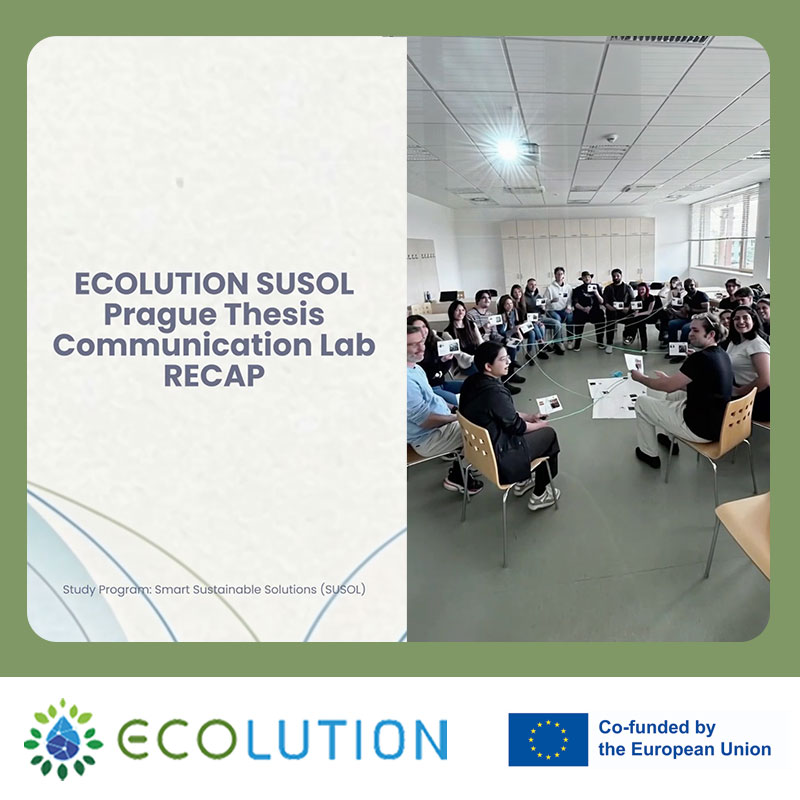
That challenge became the focus of the two-day SUSOL Prague Thesis Communication Lab, held as part of the ECOLUTION Project mobility in Prague.
Rather than concentrating solely on research content, the Communication Lab encouraged students to think about how they communicate their ideas, why their work matters, and how they can connect with audiences beyond their immediate academic field.
The activities built on the students’ ongoing Master’s thesis projects and transformed them into opportunities for reflection, storytelling, and practical communication training.
The lab began by asking students to look beyond their research questions and consider the journeys that brought them to their thesis topics in the first place.
🎬 Watch the highlights from the SUSOL Prague Thesis Communication Lab: https://youtube.com/shorts/xilfcNEmlHs
Participants reflected on questions such as:
- Why did this research journey begin?
- What challenge or gap are they hoping to address?
- How has their ECOLUTION and Erasmus+ experience influenced their thinking?
- What contribution do they hope their work will make?
These reflections helped students identify the broader context behind their research and the motivations that often remain hidden within academic writing.
Throughout the Communication Lab, students gradually built a communication strategy around their thesis work.
During the first day, they developed communication building blocks linked to their research motivations and their Erasmus+ experiences. They transformed thesis ideas into concise pitches, explored how to explain complex topics more clearly, and recorded first versions of short thesis videos.
The second day shifted the focus from generating ideas to refining them.
Students developed a more structured Master’s Thesis Communication Plan, exploring how different audiences might engage with their work and what messages they wanted those audiences to remember. The communication plans included several interconnected elements, such as defining the purpose of their message, identifying the challenge their research addresses, clarifying their research aims, considering appropriate audiences, and determining the tone and visual style of their communication.
One of the central frameworks introduced during the lab was the concept of the Researcher’s Journey.
Instead of presenting research as a finished product, students were encouraged to view it as an evolving process. This journey included several stages:
- The initial motivation behind the thesis topic
- The challenge or problem being explored
- The process of researching, testing, and analysing
- The influence of exchange experiences and peer learning
- Emerging insights and reflections
- The potential contribution of the research
This approach allowed students to frame their work as a story of curiosity, development, and discovery rather than a collection of isolated findings.
The Communication Lab also introduced practical outputs that students could continue using beyond Prague.
Participants refined their 30-second thesis reels, and finalised their videos in the ECOLUTION SUSOL Video Lab.
They also planned longer documentary-style videos that could capture the development of their research over time, from the first spark of an idea to the final stages of their projects.
Alongside video creation, students designed a small content trail consisting of social media ideas connected to their thesis journeys. These included sharing the motivation behind their research, highlighting meaningful moments from the mobility experience, and communicating the potential contribution of their work.
Practical considerations were also part of the training. Sessions covered editing techniques, accessibility measures such as subtitles and captions, responsible communication practices, and privacy considerations when creating and sharing content. Students worked together, offered peer feedback, and supported one another throughout the process.
Students gained experience in translating specialised knowledge into language that wider audiences can understand. They explored how authenticity, clarity, and creativity can strengthen research communication, while also recognising that communicating science is increasingly important in professional contexts.
Research does not end when a thesis is submitted. Its impact often depends on whether others can understand it, connect with it, and recognise why it matters.
The SUSOL Prague Thesis Communication Lab provided the ECOLUTION Project students with an opportunity to develop exactly those skills: helping them move from simply conducting research to confidently sharing the stories behind it.
Funding Agency: EACEA – European Education and Culture Executive Agency
Learn more about ECOLUTION: https://www.ecolutionmsc.eu/
101140050 — ECOLUTION — ERASMUS-EDU-2023-PI-ALL-INNO
Disclaimer: Funded by the European Union. Views and opinions expressed are however those of the author(s) only and do not necessarily reflect those of the European Union or the European Education and Culture Executive Agency (EACEA). Neither the European Union nor EACEA can be held responsible for them.