Feedback Should Help You Grow, Not Hold You Back:
How the O.P.E.N. Framework Transforms Feedback into Collaboration
Putting thoughts, care, energy, and creativity into a project can make sharing it difficult. The moment someone begins offering critical feedback, our bodies often react before our minds do: an elevated heart rate, sudden defensiveness, tension in the shoulders, and an inner voice asking whether our work, or our worth, is being attacked.
Whether facilitating an international workshop, proposing a new community initiative, or publishing creative work, receiving feedback can feel intimidating. Either we are afraid of hurting someone else’s feelings, or our own feelings get hurt.
On 8 October 2026, the international learning community gathered for Session 3 of the 30-week EAC EMPOWER Impact Series, which was a dedicated HATE-LESS Train-the-Trainer workshop, to explore “Kind & Constructive Feedback” within Learning Cycle 1: Safe Space.
Create Safe Spaces to Receive Feedback
Participants explored how to create safe environments to give and receive feedback. They learned about:
- Grounding & Visualization: Regulating the nervous system to remain centered and emotionally secure when hearing difficult feedback.
- The Territory Mindset: Operating territorially, doing the work for its own sake rather than tying our self-worth to comparison, status, or external approval.
- 7 Steps of Feedback Delivery: We explored seven steps recommended by The Center for Leadership Studies: creating an emotionally safe space, starting with appreciation, providing specific and kind feedback, inviting dialogue, collaborating on potential solutions, expressing confidence in someone’s growth, and following up to normalize the process.
From Reflection to Practice: The O.P.E.N. Guide Framework
Participants created practical guides using the O.P.E.N. Feedback Framework, sharing four key takeaways in their co-created participatory video:
- O – OBSERVE: Notice emotional resistance, thoughts, and tension without reacting defensively.
- P – PAUSE: Take a slow breath and return to a grounded, emotionally safe space before speaking.
- E – ENGAGE: Enter dialogue with curiosity, active listening, and mutual respect.
- N – NEXT STEP: Turn honest insight into one actionable adjustment to keep building momentum.
A Global Community Building Psychological Safety
A heartfelt thank you goes out to all the educators, trainers, youth leaders, and young creators from across Europe and partner countries who joined Session 3!
By sharing personal experiences with feedback, creating a safe environment together, and creating OPEN Feedback guides, you proved that feedback can build people up rather than tear them down.
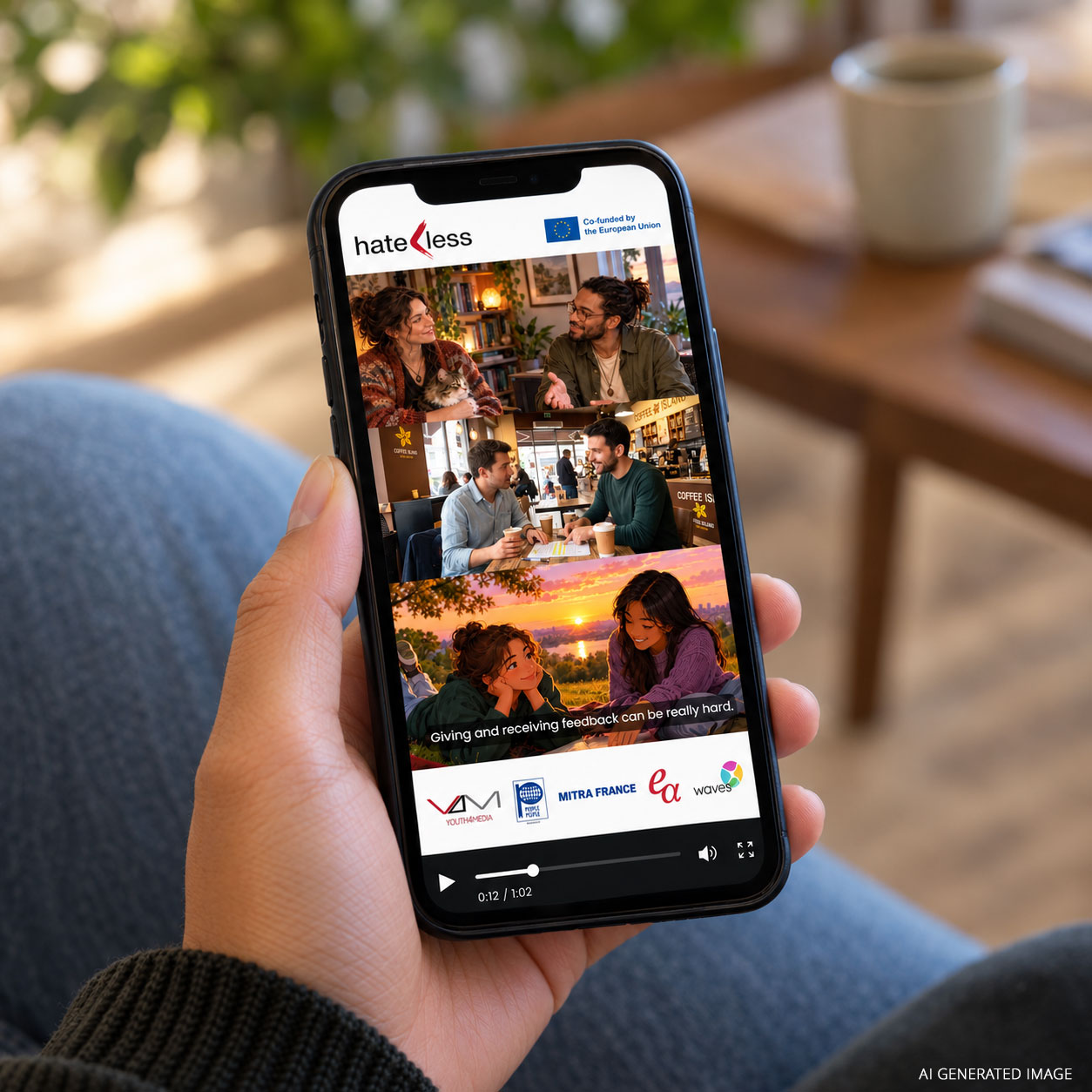
Watch the Participatory Video: More Love, Less Hate
To celebrate the submissions from Session 3, our participants co-created this participatory montage collage, bringing their visual and written OPEN Feedback Guides together:
🎥 Watch the Session 3 Participatory Video:
https://youtube.com/shorts/zJsHk5_M7OU
Key Takeaway: Real-World Feedback Gives Us Traction
Constructive feedback is not the opposite of kindness; it is an act of care. When feedback is delivered with respect and received with an open, grounded mindset, it turns uncertainty into clear direction.
Create space to listen, offer feedback with kindness, and take the next step. More love, less hate.
Explore the Session 3 Learning Resources:
⇒ Session 2 & 3 Focus & Constructive Growth Podcast Short Brief
⇒ Arty Escape Room Game (Mentimeter)
⇒ Session 3 Quiz on ICARUS AI E-Learning
⇒ Course 1 – Safe Space – ICARUS AI e-Learning
⇒ Learn more about the full series: https://ea.consulting/empower-impact-series/
Funding Agency: JUGEND für Europa
Learn more about HATE-LESS: https://hate-less.eu
Project: 2024-1-DE04-KA220-YOU-000244181
Disclaimer: Co-financed by the European Union. The opinions and points of view expressed are solely those of the author(s) and do not necessarily reflect those of the European Union or of the JUGEND für Europa (German National Agency for Erasmus+ Youth, Erasmus+ Sport and the European Solidarity Corps).