Collaborating as Equals: Building Trust Without Micromanagement
When teamwork lacks clear boundaries, communication can quickly break down into micromanagement. Instead of combining their strengths, creative professionals may find themselves competing for control, struggling to trust one another, or feeling that their contributions are undervalued.
Why does this happen? Without a foundation of trust, teams easily default to micromanagement.
On 5 November 2026, participants from across Europe explored these questions during Collaborating as Equals, Session 7 of the EAC EMPOWER Impact Series.
This interactive session continued Learning Cycle 2: Professional Equity, focusing on building trust, respecting creative autonomy, and collaborating on equal footing, and was hosted as a DigiCreate Empower Virtual Exchange by Evolutionary Archetypes Consulting SL (EAC).
Learning Cycle 2: Professional Equity
The EAC EMPOWER Impact Series features 30 free weekly online workshops running from September 2026 to April 2027. The learning journey explores six progressive cycles:
-
- Safe Space (Sessions 1–5)
- Professional Equity (Sessions 6–10)
- Mutual Value (Sessions 11-15)
- Constructive Validation (Sessions 16-20)
- Sustainable Growth (Sessions 21-25)
- Self-Awareness (Sessions 26-30)
In Learning Cycle 1, we learned how to create a safe, collaborative foundation. Now, in Learning Cycle 2, we explore professional equity. Our sovereign archetype, Gweni, guides us on this journey.
Gweni teaches us an essential principle. Equal dignity does not mean making everyone identical. Instead, genuine professional equity means bringing every seat around the circle to the same level.
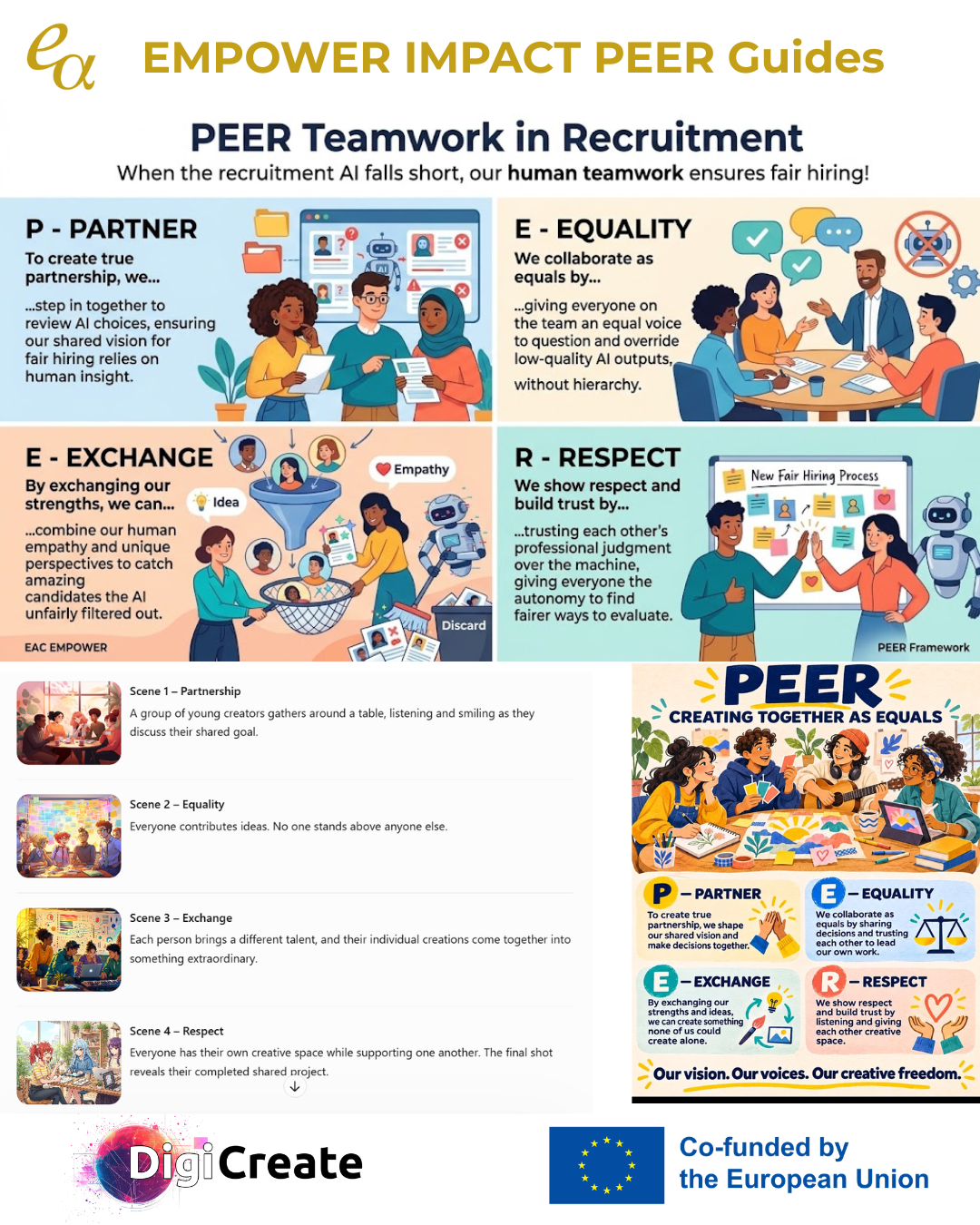
Discovering Our Strengths Through the PRISMA Team Roles Test
A central activity of Session 7 invited participants to explore their individual contributions through the PRISMA Team Roles Test.
By examining the nine team roles, participants reflected on how different working styles, talents, and perspectives can complement one another.
Rather than expecting everyone to approach tasks in the same way, the exercise encouraged participants to recognize that effective teamwork depends on combining diverse strengths toward a shared purpose.
The discussion also drew inspiration from Steven Pressfield’s The War of Art, particularly his concept of territorial work. Participants explored how developing confidence in their own creative territory can help them contribute without constantly seeking external approval or competing for status.
The central message was clear: A team becomes stronger when individuals understand their strengths, respect each other’s contributions, and work together without unnecessary hierarchy.
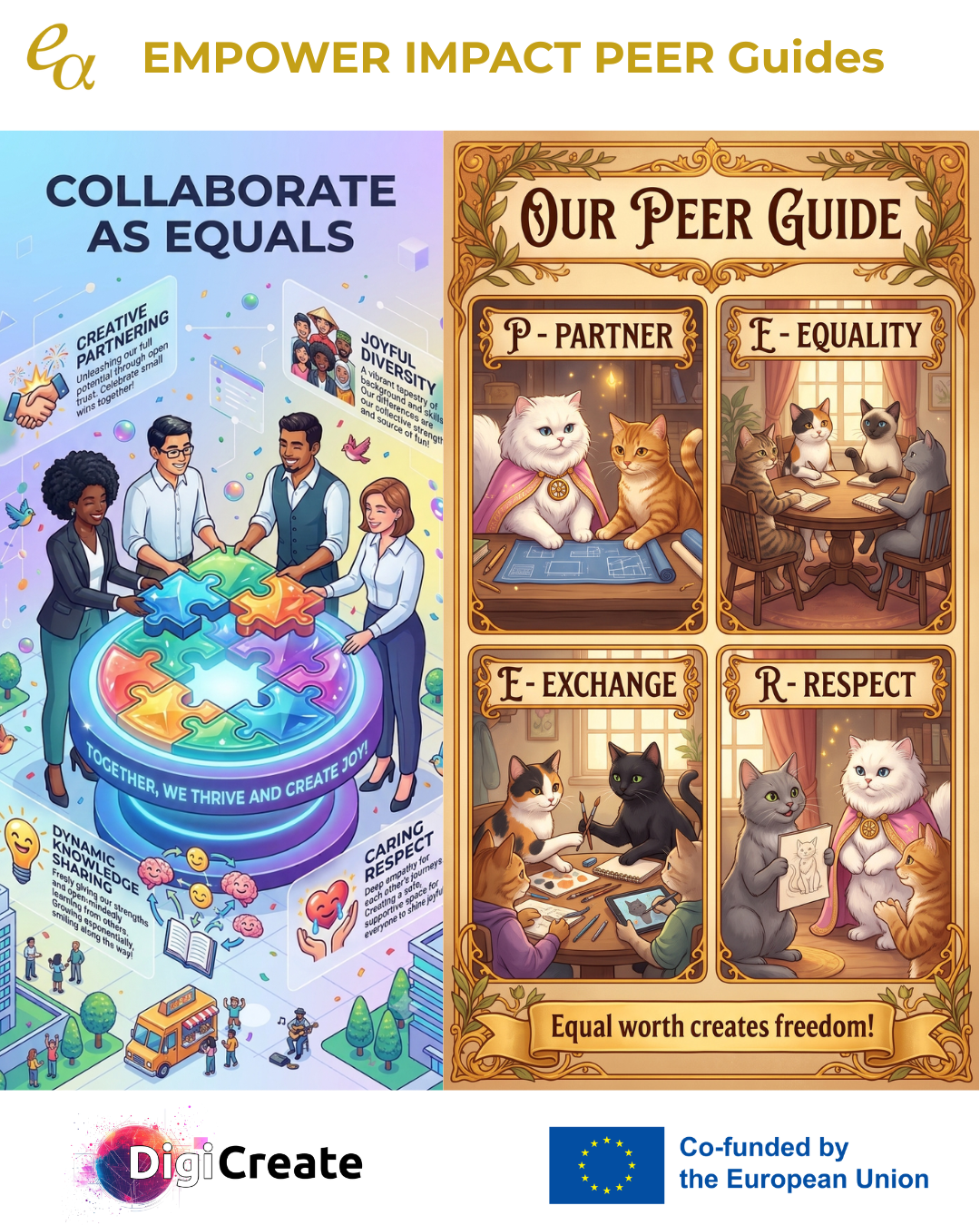
Turning Professional Equity into Practice: The P.E.E.R. Framework
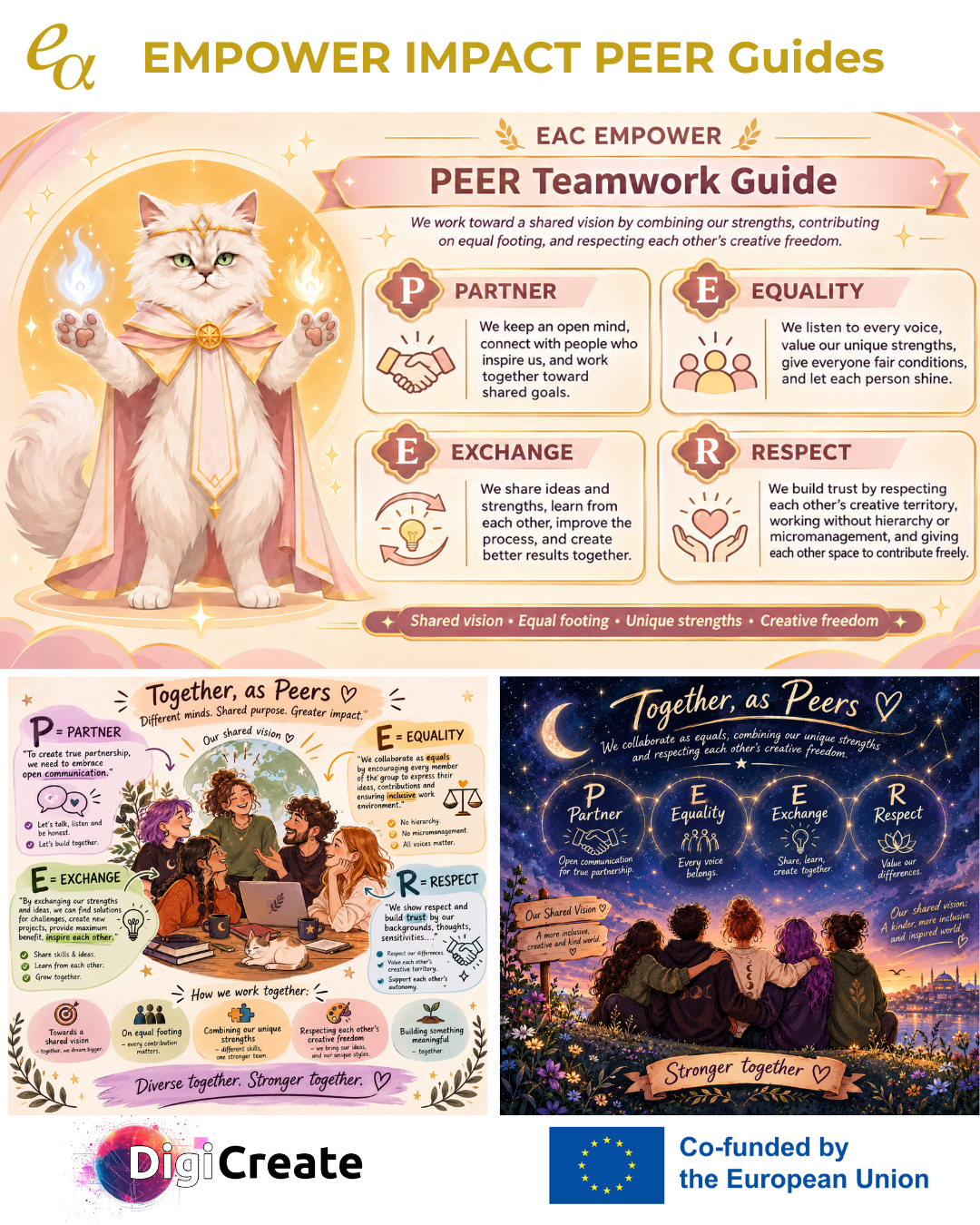
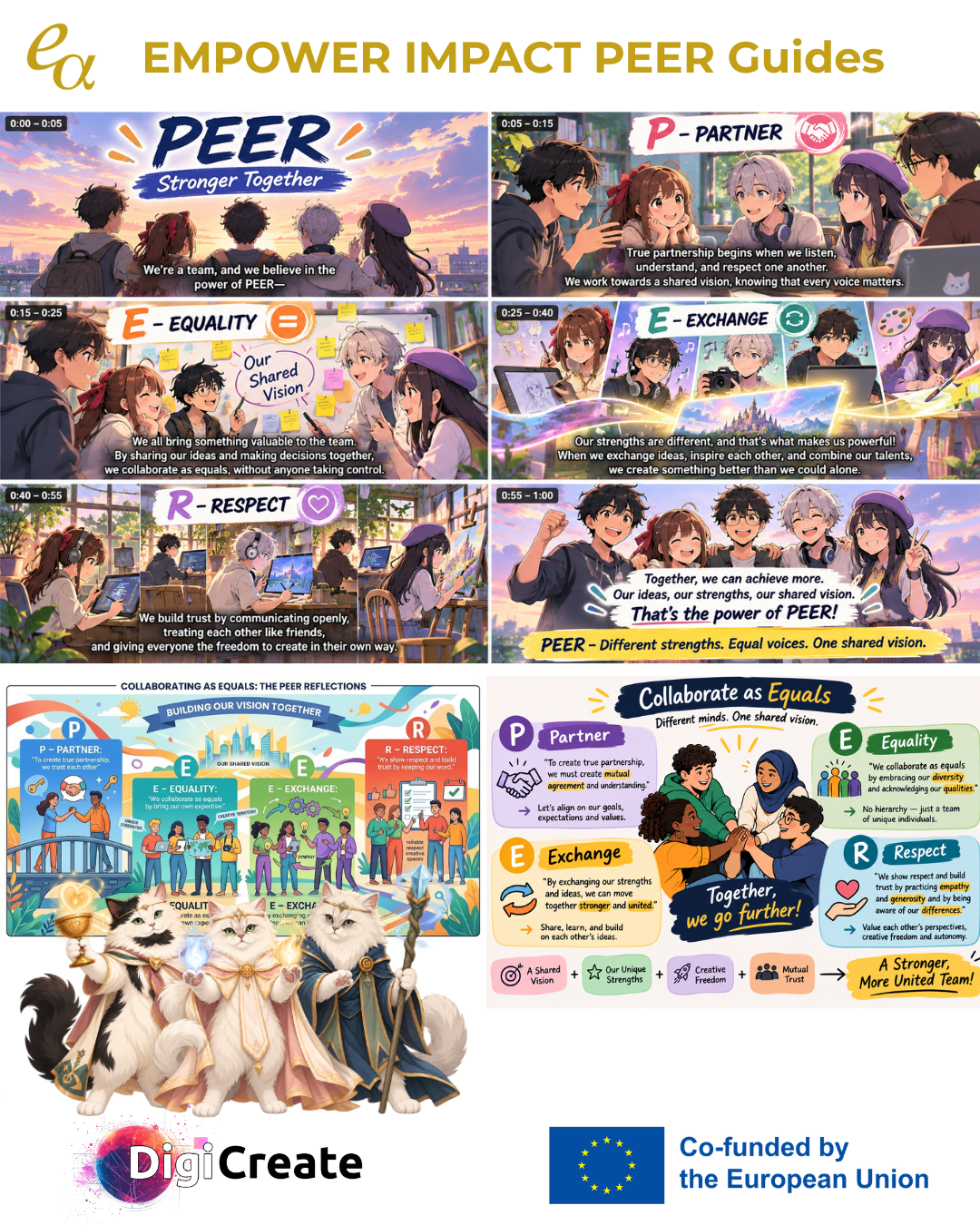
Building on these reflections, participants explored the P.E.E.R. Framework, a practical approach to collaborating as equals:
- P – Partner: Build trust and work together toward a shared goal.
- E – Equality: Recognize the equal dignity and value of every contribution.
- E – Exchange: Share knowledge, experiences, and complementary strengths.
- R – Respect: Honor individual differences, boundaries, and creative autonomy.
Participants translated these principles into their own visual P.E.E.R. Guides, illustrating how collaboration can become more inclusive, empowering, and effective.
These guides transformed the session’s central ideas into practical strategies for everyday teamwork, from encouraging open communication and sharing responsibilities to recognizing diverse contributions without creating unnecessary hierarchies.
As Gweni reminds us, equal worth creates freedom. True collaboration flourishes when differences are celebrated rather than ranked, allowing individuals to support one another’s growth.
Building Teams Where Everyone Can Thrive
Session 7 demonstrated that professional equity is not about eliminating differences or expecting everyone to contribute in identical ways. It is about creating conditions in which different strengths can work together.
Through individual reflection, interactive activities, and the creation of P.E.E.R. Guides, participants explored how trust, equality, exchange, and respect can strengthen creative collaboration.
By moving beyond micromanagement and competition, teams can create environments where everyone has the confidence, autonomy, and opportunity to contribute.
Watch Gweni’s video:
https://www.youtube.com/watch?v=T3bNukxAXPs
Explore Series and Project Resources
- Podcast: https://tinyurl.com/Session-7-Podcast
- Gweni Creative Quest Game (Mentimeter): https://www.menti.com/ala1c8xqxu1x
- Explore the PRISMA Team Role Test: https://prismatest.net/tests/team-roles-test/
- Learn more about the full series: https://ea.consulting/empower-impact-series/
- Watch the Session 7 Video:
https://youtu.be/DFg0-wn-vAw
Official Website of the Erasmus+ Virtual Exchange Project DigiCreate: https://digicreate-empower.eu/
Consortium Partners:
- Youth Power Germany EV (YP-DE) (Germany)
- Evolutionary Archetypes Consulting SL (EAC) (Spain)
- Cooperativa Para O Desenvolvimento E Coesão Social, CRL (Contextos) (Portugal)
- Univerzitet Union Nikola Tesla (UniTesla) (Serbia)
- Udruzenje Okret (SPIN) (Bosnia and Herzegovina)
- Nevladina Organizacija GLAS (NVO GLAS) (Montenegro)
- Javna Ustanova Univerzitet Crne Gore Podgorica (UoM) (Montenegro)
- Fakultet Za Poslovnu Ekonomiju I Pravo Bar (FPEP Bar) (Montenegro)
Funding Agency: EACEA – European Education and Culture Executive Agency
101193474 — DigiCreate — ERASMUS-EDU-2024-VIRT-EXCH
Disclaimer: Funded by the European Union. Views and opinions expressed are however those of the author(s) only and do not necessarily reflect those of the European Union or the European Education and Culture Executive Agency (EACEA). Neither the European Union nor EACEA can be held responsible for them.