Beyond the Headset: What Happens When Extended Reality Hits the Assembly Line?
It is easy to showcase Extended Reality in a tech showroom or an academic computer lab. You put on a clean headset, step into an empty room, and test a virtual simulation under ideal lighting and total silence.
Step onto an active heavy-vehicle manufacturing floor, and reality looks very different.
Factory operators work with heavy tools, tight shift deadlines, ambient noise, and complex wiring harnesses. If an augmented reality interface lags by half a second, blocks their peripheral vision, or complicates their workflow, they will take it off immediately.
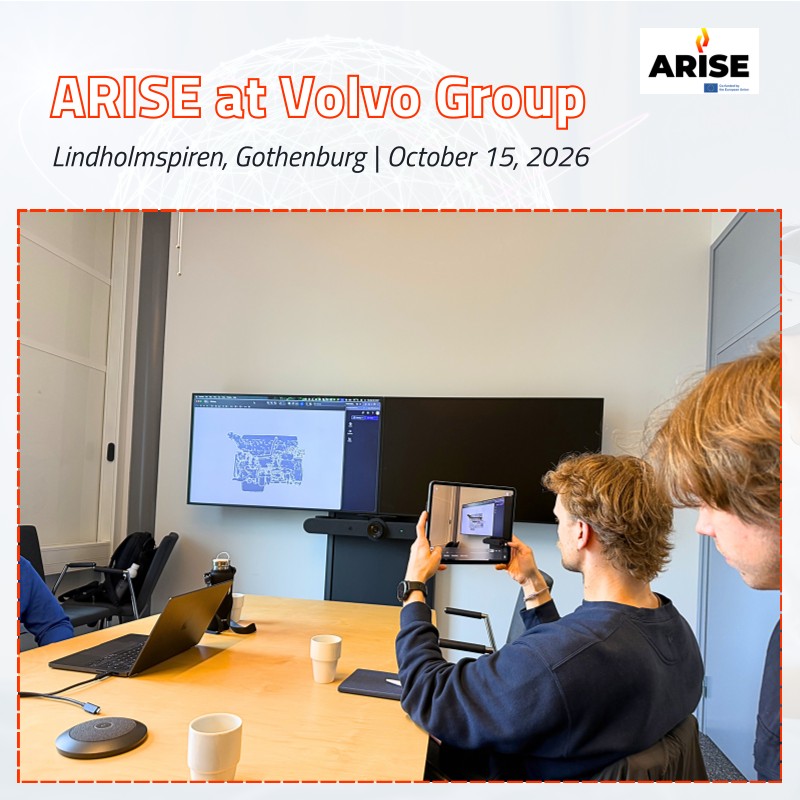
Last week, as part of the ARISE (Advanced Realities for Innovation and Skills Enhancement) project, researchers from our academic partner KTH Royal Institute of Technology (Nils Merkel, Oskar Hokkanen, and Jan Gulliksen) travelled to the Volvo Group facilities in Gothenburg to examine how immersive technologies operate in daily industrial production.
Hosted by the Volvo Group team (Ewa Miernik, Małgorzata Koszałkowska, Kim Vidard, Mattias Andersson, Lars Ahnér), the visit provided a direct look at how immersive tools solve practical manufacturing problems.
The Big Takeaway: XR Is a Human-Computer Interaction Problem, Not Just a Software One
The Gothenburg visit reinforced an important lesson: successful XR solutions depend on more than advanced technology. They must respond to real operational needs and be designed around the people who use them.
Developing effective immersive experiences requires combining technical expertise with an understanding of human learning, workplace environments, and practical challenges. For researchers, developers, and educators, this means considering:
- Real-world applications: How immersive technologies can support specific tasks, improve training, and address practical business needs.
- Learning and teaching methods: How established educational approaches can be adapted to the unique strengths and limitations of immersive technologies.
- Choosing the right technology: When VR training, tablet-based AR, or projected AR offers the most suitable solution for a particular task or learning objective.
Ultimately, the value of XR lies not in how sophisticated the technology is, but in how effectively it supports people in learning, working, and solving real-world problems.
Why Ground-Level Industry Visits Drive the ARISE Curriculum
This direct feedback loop between the shop floor and the lecture hall is the founding principle of ARISE.
Supported by the European Health and Digital Executive Agency (HaDEA) under the Digital Europe Programme, the ARISE initiative unites 13 universities, research centres, and industrial innovators across Europe to train over 150 postgraduate specialists.
By learning directly from industry leaders like Volvo Group, our consortium ensures that our double-degree master’s curriculum and self-standing online modules do not teach speculative concepts. We teach future engineers to design immersive tools that withstand the practical pressures of European manufacturing.
A sincere thank you to the Volvo Group team in Gothenburg for opening their doors and sharing their operational insights!
Official Website of the EU-Co-Funded Project ARISE: https://28digital.eu/eu-collaborations/arise
Consortium Partners:
- 28DIGITAL (28DGTL)
- Aalto University (AALTO)
- Universidad Politécnica de Madrid (UPM)
- KTH Royal Institute of Technology (KTH)
- Politecnico di Milano (POLIMI)
- University of Twente (UT)
- Linköping University (LIU)
- University of Trento (UNITN)
- Evolutionary Archetypes Consulting SL (EAC)
- Tech Valley Management (TECHVALLEY)
- University of Rennes (UNIVREN)
- Université Libre de Bruxelles (ULB)
- Fifth Ingenium (FIFTH)
European institutions & programs:
- DigitalEurope
- Funding Agency: European Health and Digital Executive Agency (HaDEA)
e-Learning Platform: https://eit.icarus.education/arise/
Project Number: 101225600 — ARISE — DIGITAL-2024-ADVANCED-DIGITAL-07-KEYCAPACITY
Co-funded by the European Union. Views and opinions expressed are however those of the author(s) only and do not necessarily reflect those of the European Union or HADEA. Neither the European Union nor the granting authority can be held responsible for them.