Designing for the Edge of Survival: Inside the DEXTER Partnership
.When you design a structure on Earth, you take basic environmental constants for granted: a breathable atmosphere, a standard gravitational pull, and abundant natural resources.
Designing an off-Earth habitat strips away every single one of those assumptions.
On the Moon or Mars, architecture becomes an extreme survival puzzle involving radiation shielding, microgravity mechanics, closed-loop life support, and severe resource scarcity. Solving these challenges requires far more than aesthetic drafting; it demands deep space physics, specialised digital learning environments, and commercial incubation.
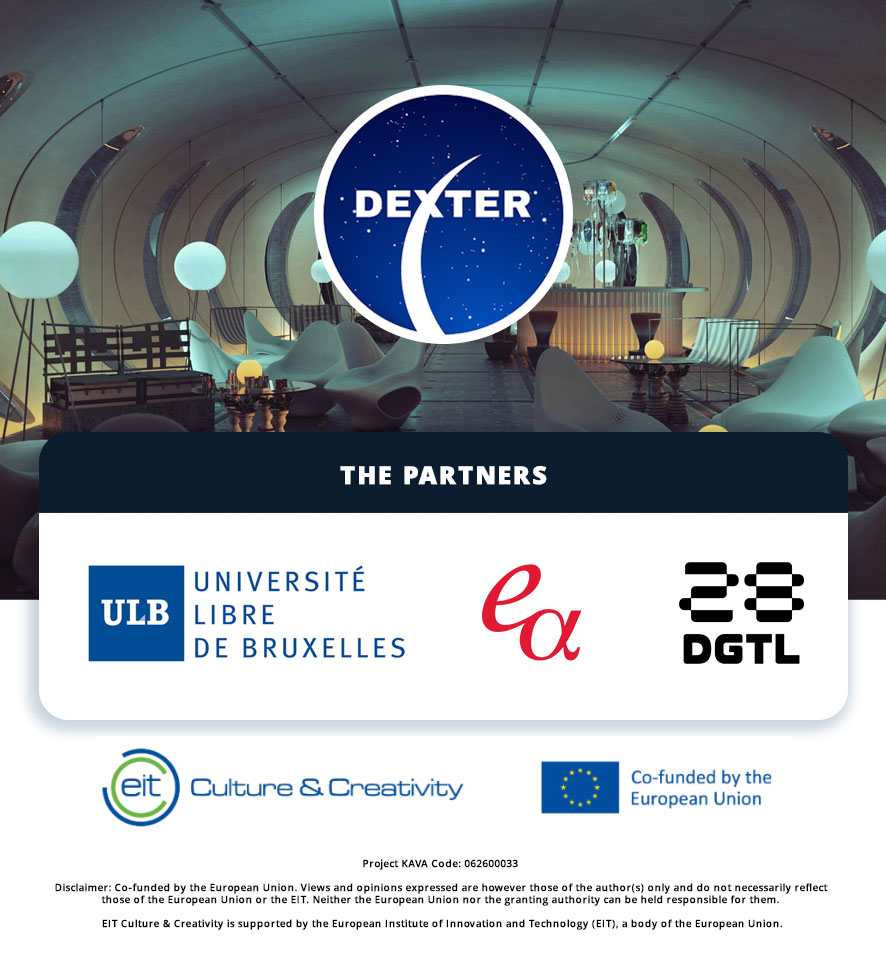
To build Europe’s doctoral training in this emerging field, the DEXTER project relies on a focused consortium of three partners. Each partner anchors a critical side of the European Knowledge Triangle: higher education, technical innovation, and enterprise.
The Three Pillars of DEXTER
1. Academic Leadership & Research: Université Libre de Bruxelles (ULB)
As the project lead, ULB provides the scientific depth and university accreditation. Through the Centre for Research and Engineering in Space Technologies (CREST), ULB structures the core doctoral curriculum across two interconnected courses:
- Creative Horizons: Exploring speculative, human-centred living concepts and spatial aesthetics in extreme environments.
- Materials, Systems, and Engineering of Extraterrestrial Habitats: Validating construction feasibility, in-situ resource utilisation, and closed-loop environmental controls.
ULB ensures that doctoral work remains anchored in verified aerospace science and formal degree accreditation.
2. Digital Infrastructure & Hybrid Delivery: Evolutionary Archetypes Consulting SL (EAC)
Advanced space architecture training needs to be accessible across European borders without requiring candidates to relocate permanently. EAC provides the digital learning backbone through the ICARUS platform.
EAC is responsible for:
- Building and managing the hybrid digital learning environment.
- Integrating VR/AR design tools and digital twins so candidates can test spatial layouts in simulated microgravity.
- Implementing WCAG digital accessibility standards to ensure equitable access for international researchers.
3. Coordination & Entrepreneurial Transfer: 28DIGITAL
A doctoral thesis should not gather dust on a shelf. 28DIGITAL oversees general project management, KPI tracking, and business creation.
By embedding entrepreneurship directly into the academic syllabus, 28DIGITAL trains researchers to convert extreme architectural solutions into market-ready ventures.
Candidates learn intellectual property governance, create business model canvases, and present industry pitches focused on circular construction and modular housing back on Earth.
How the Consortium Complements Each Other
The strength of DEXTER lies in how these three roles reinforce one another:
- Science meets Application: ULB ensures scientific rigour, while 28DIGITAL connects research findings to commercial and social impact.
- Access meets Innovation: The e-learning platform, developed by EAC removes geographic barriers, allowing candidates across Europe and RIS regions to collaborate in real-time digital labs, and also offering translated subtitles for video courses.
- Space Reciprocity: Solutions developed for extraterrestrial survival (such as water recycling and low-energy construction) are channelled into sustainable built environments on Earth.
Without ULB, there is no accredited aerospace grounding. Without EAC, the digital accessibility and simulation tools are missing. Without 28DIGITAL, the entrepreneurial pipeline to industry is lost. Together, they deliver a comprehensive educational framework for future space architects.
Official Website of the EU-Co-Funded Project DEXTER: https://crest.ulb.be/dexter/
Consortium Partners:
- Université Libre de Bruxelles (ULB)
- Evolutionary Archetypes Consulting SL (EAC)
- 28DIGITAL (28DGTL)
European institutions & programs:
- Funding Agency: European Institute of Innovation and Technology (EIT)
- Programme: EIT Culture & Creativity
e-Learning Platform: https://28digital.ea.education/dexter/
Project KAVA Code: 062600033
Co-funded by the European Union. Views and opinions expressed are however those of the
author(s) only and do not necessarily reflect those of the European Union or the EIT. Neither the European Union nor the granting authority can be held responsible for them.
EIT Culture & Creativity is supported by the European Institute of Innovation and Technology (EIT), a body of the European Union.