Designing for Life Beyond Earth: Introducing the DEXTER Project
When most people picture space exploration, they think of rockets, launchpads, and orbital physics. But as missions stretch into months and years, from long-duration orbital stations to permanent lunar bases, a new question takes centre stage: how do people actually live, work, and survive inside these environments?
Solving that problem requires more than conventional aerospace engineering. It takes architects, human-centred designers, and circular-systems specialists working hand-in-hand with space engineers.
That intersection is why the DEXTER project was created. Supported by the European Union (EU) through EIT Culture & Creativity, DEXTER is building an interdisciplinary curriculum designed specifically for researchers, doctoral candidates, and engineers working at the frontier of space architecture.
What is DEXTER?
Coordinated by CREST (the Centre for Research and Engineering in Space Technologies at the Université Libre de Bruxelles), DEXTER focuses on the practical design challenges of extreme environments.
Designing a lunar base or an orbital laboratory is completely different from designing a building on Earth:
- Every cubic metre of pressurised volume matters.
- Life support systems have to be closed-loop and zero-waste.
- The psychological and physical well-being of the crew depends directly on light, acoustic design, and ergonomics.
- Structural materials must endure extreme radiation, vacuum, and thermal swings.
Rather than treating these as afterthoughts, DEXTER embeds architectural thinking straight into space engineering from day one, giving researchers the cross-disciplinary tools they need to design real habitats.
What We Are Doing at EAC: The Digital Learning Platform
High-level space research often stays locked inside specialised academic labs. Our role at Evolutionary Archetypes Consulting SL (EAC) is to make sure this knowledge turns into structured, practical digital training that researchers across Europe can actually use.
Within the DEXTER consortium, EAC is leading the e-learning architecture and digital course production:
- Providing the e-learning platform environment: We developed and deployed the project’s dedicated online e-learning platform, tailored to the technical requirements of doctoral coursework.
- Structuring the Curriculum: We help translate complex technical papers into intuitive, modular learning units and provide automated subtitles and translations for videos.
- Interactive Content: Instead of static slide decks and long PDFs, we are creating media-rich modules that combine technical data, 3D spatial concepts, and applied exercises.
The learning platform is live and ready for upcoming course rollouts:
👉 Explore the DEXTER e-Learning Platform: https://28digital.ea.education/dexter-2/
What’s Next?
With the e-learning foundation in place, the consortium is preparing to roll out initial modules for PhD candidates and researchers. Next week, we will highlight the consortium partners behind the project and share an overview of the specific subjects covered across the curriculum.
Official Website of the EU-Co-Funded Project DEXTER: https://crest.ulb.be/dexter/
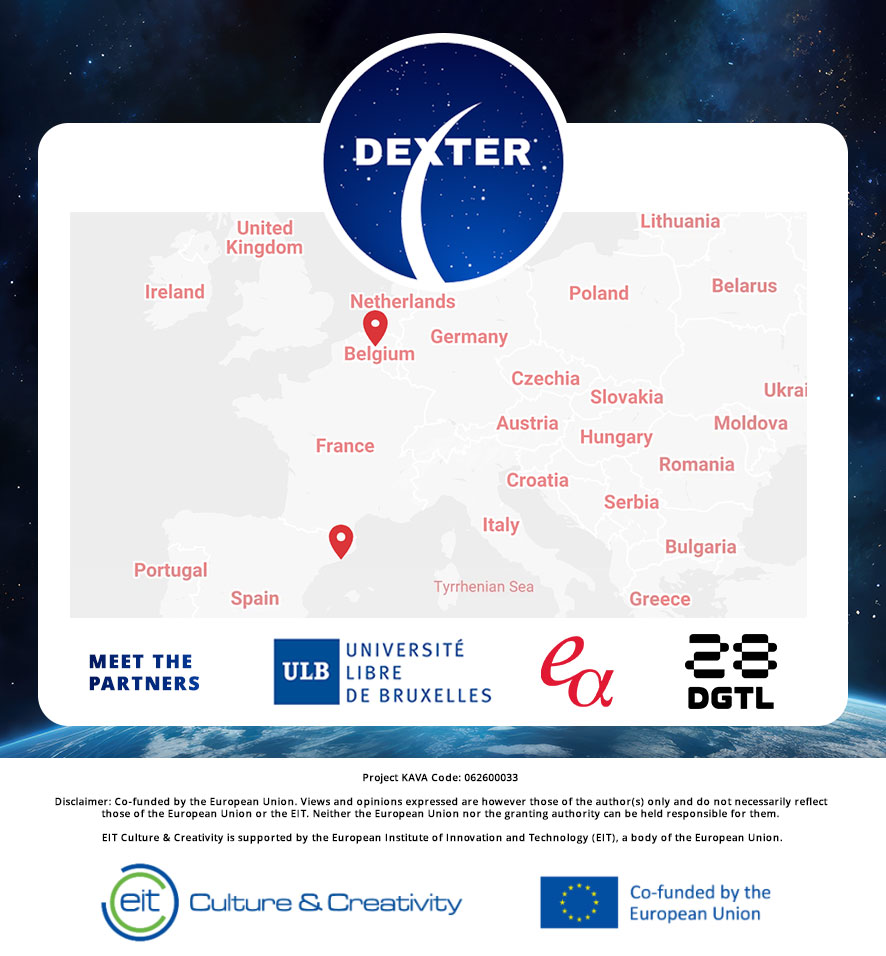
Consortium Partners:
- Université Libre de Bruxelles (ULB)
- Evolutionary Archetypes Consulting SL (EAC)
- 28DIGITAL (28DGTL)
Project KAVA Code: 062600033
Co-funded by the European Union. Views and opinions expressed are however, those of the
author(s) only and do not necessarily reflect those of the European Union or the EIT. Neither the European Union nor the granting authority can be held responsible for them.
EIT Culture & Creativity is supported by the European Institute of Innovation and Technology (EIT), a body of the European Union.