Europe’s Gateway to Supercomputing Training: Highlights from EuroHPC User Days 2026
Building world-class supercomputers is only half the battle. Finding the engineers and domain specialists who know how to deploy, optimise, and push code to them is another challenge entirely.
Across Europe, massive capital investments have established top-tier computational clusters like LUMI, Leonardo, and MareNostrum 5. Yet as hardware infrastructure expands, a persistent question remains: where will the next generation of engineers come from?
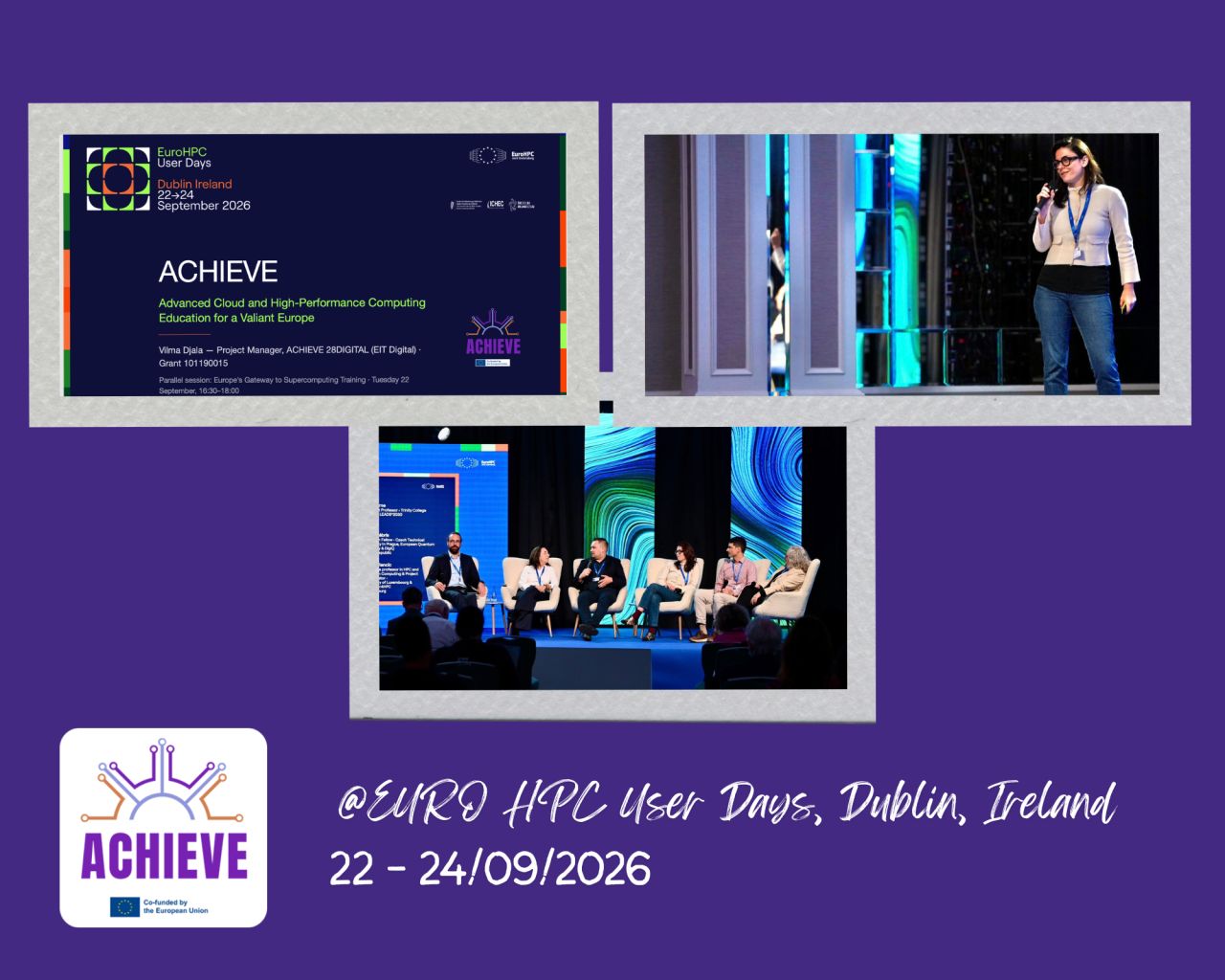
To tackle this challenge directly, academic leaders, researchers, and project coordinators met at the EuroHPC User Days 2026 in Dublin. Among the core discussions was the panel session titled “Europe’s Gateway to Supercomputing Training.”
Representing ACHIEVE on the European Stage
Project Manager Vilma Djala represented ACHIEVE on the Dublin panel.
The session was moderated by Daniel Opalka, Head of Research & Innovation at the EuroHPC Joint Undertaking (EuroHPC JU). It convened leading European initiatives dedicated to advanced technical training:
- Aurél Gábris – European Quantum Academy & DigiQ, Czech Technical University in Prague
- Julie Byrne – LEADSx2030, Trinity College Dublin
- Maria-Ribera Sancho — EVITA, Universitat Politècnica de Catalunya & Barcelona Supercomputing Center
- Marko Rancic – EUMaster4HPC, University of Luxembourg
Together, the panellists addressed the operational realities of technical capacity building: how to widen access for learners, help candidates navigate course options, certify specialised skills, and sustain advanced educational programmes beyond initial EU funding cycles.
Two Educational Pathways for Advanced Computing
During the panel, Vilma Djala outlined the two distinct yet complementary routes ACHIEVE provides into advanced computing:
- Integrated Master’s Programmes for Emerging Talent: Comprehensive graduate degrees designed to build deep theoretical mastery and system-level competence. This includes the Cloud Networks & Infrastructure High Performance Computing (CNIHPC) double-degree master’s pathway, where students complete embedded master’s theses and practical internships directly within major industry environments like Amazon Web Services (AWS) and Infineon Technologies.
- Flexible, Certifiable Modules for Working Professionals: Modular online learning paths that enable engineers, researchers, and technical managers to upskill independently in parallel computing, distributed storage, and cloud acceleration without putting their careers on hold.
By combining foundational graduate degrees with modular continuing education, ACHIEVE ensures that training opportunities adapt to both university students and industry professionals already in the field.
Explore ACHIEVE Learning Opportunities
Whether you are an aspiring graduate student looking to specialise in distributed systems or a working engineer seeking advanced certification, ACHIEVE offers direct pathways into Europe’s high-performance computing ecosystem.
Official Website of the EU-Co-funded project ACHIEVE: https://28digital.eu/eu-collaborations/achieve
Consortium Partners:
- 28DIGITAL (28DGTL)
- 28DIGITAL Spain (28DGTL ES)
- University of Trento (UNITN)
- Middle East Technical University (METU)
- University of Rennes (UR)
- KTH Royal Institute of Technology (KTH)
- Babeș-Bolyai University (UBB)
- Aalto University (AALTO)
- Polytechnic University of Milan (POLIMI)
- University of Novi Sad (UNS FTN)
- Evolutionary Archetypes Consulting SL (EAC)
- Techvalley Management (TECHVALLEY)
- Infineon Technologies (INFINEON)
- ODTÜ Teknokent (OBTUTEK)
- Scientific and Technological Research Council of Turkey (TUBITAK)
Associated Partners
- Research Institutes of Sweden (RISE)
- Amazon Web Services (AWS)
European institutions & programmes:
Funding Agency: European Health and Digital Executive Agency (HaDEA)
e-Learning Platform (in case the post is about online classes): https://eit.icarus.education/achieve/
101190015 — ACHIEVE — DIGITAL-2023-SKILLS-05
Disclaimer: Co-Funded by the European Union. Views and opinions expressed are however those of the author(s) only and do not necessarily reflect those of the European Union or HADEA. Neither the European Union nor the granting authority can be held responsible for them.