Tuning Out the Roar: Community Insights on Transport Noise in European Cities
Traffic, commuter rail, and low-altitude aircraft have become standard background noise in modern city life. Over time, residents learn to tune out the continuous hum of engines and wheels on asphalt.
Yet tuning out noise mentally does not stop its physical impact. Chronic acoustic stress is far more than an everyday inconvenience; prolonged exposure slowly chips away at sleep quality, elevates chronic stress, and undermines long-term health.
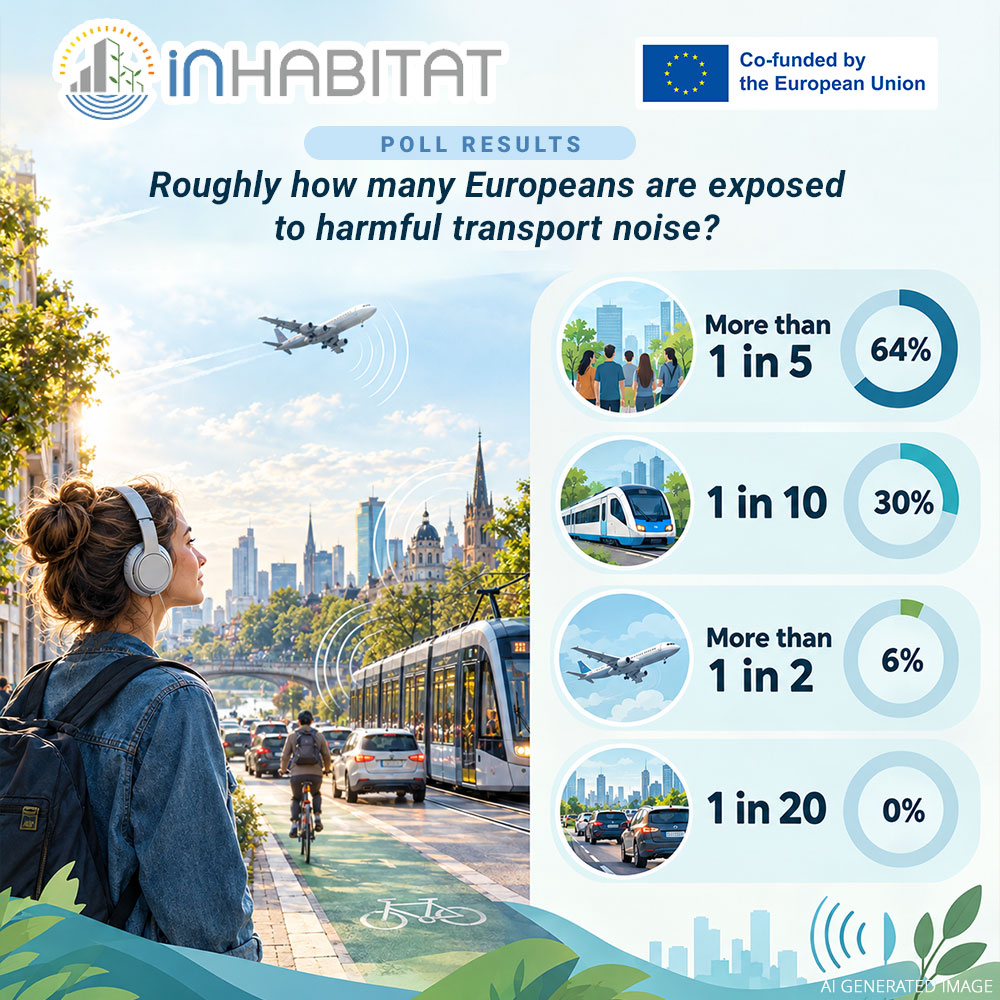
To understand how our community perceives the scale of this invisible challenge, the INHABITAT project ran a poll across LinkedIn, X, and Instagram asking: Roughly how many Europeans are exposed to harmful transport noise?
The Poll Results: A Clear Community Consensus
Over the course of two weeks, professionals, students, and urban researchers cast their votes. Here is how the community answered:
- More than 1 in 5: 64%
- 1 in 10: 30%
- More than 1 in 2: 6%
- 1 in 20: 0%
The overwhelming majority correctly identified the scale of the issue. Broadly across the continent, at least one in five urban residents lives in areas where everyday transport noise reaches levels considered disruptive to regular rest and wellbeing.
The fact that nearly two-thirds of respondents selected the highest accurate range shows that citizens and professionals no longer dismiss acoustic pollution as a secondary issue. They recognise it as an urgent urban planning failure.
EU environmental data shows that over 20% of Europeans live with harmful transport noise levels every day.
Why Passive Sound Barriers Are Not Enough
The European Environment Agency calls for stronger action to reduce transport noise. Its recommendations combine practical improvements to transport systems with longer-term urban planning:
- Reduce road noise: Lower urban speed limits and encourage low-noise tyres.
- Improve rail and aviation operations: Maintain railway infrastructure and optimise aircraft take-off and landing patterns.
- Protect quiet spaces: Improve access to quiet and green areas and create buffer zones between transport corridors and homes.
- Support sustainable mobility: Promote public transport, walking and cycling.
Together, these measures offer cities several ways to reduce exposure and prevent future noise problems.
How the INHABITAT MSc Prepares the Next Generation of Urban Engineers
Designing liveable, quiet cities requires cross-disciplinary expertise. Municipal planners, civil engineers, and software architects can no longer work in isolated silos.
The INHABITAT Master of Science was established to equip students with the systemic skills necessary to transform European cities.
Source: https://www.eea.europa.eu/en/newsroom/news/europeans-exposed-to-harmful-noise-pollution-levels
Official Website of the Erasmus+ Project INHABITAT: https://www.inhabitatmsc.eu/
Consortium Partners:
- Diethnes Panepistimio Ellados (IHU)
- Politecnico di Milano (POLIMI)
- Kauno Technologijos Universitetas (KTU)
- Hochschule Rhein-Waal (HSRW)
- Cerca Trova (CT)
- Ventspils Tehnikums (VVS)
- ECQA GmbH (ECQA)
- Evolutionary Archetypes Consulting SL (EAC)
- SYSWIN Solutions Srl (SYS)
- Efesto (EF)
- InterConsult Bulgaria (ICB)
- Holonix Srl (HX)
Funding Agency: EACEA – European Education and Culture Executive Agency
101108631 — INHABITAT — ERASMUS-EDU-2022-PI-ALL-INNO
Disclaimer: Funded by the European Union. Views and opinions expressed are however those of the author(s) only and do not necessarily reflect those of the European Union or the European Education and Culture Executive Agency (EACEA). Neither the European Union nor EACEA can be held responsible for them.