Why We Learn: What Community Data Reveals About Lifelong Learning
Technological disruption is accelerating across every industry sector. Automation reshapes administrative routines, generative AI alters creative workflows, and job requirements evolve continuously. Consequently, policymakers and enterprise leaders often assume that fear drives modern professional development. They expect workers to upskill defensively simply to protect their jobs.
However, recent empirical data from our community poll challenges this conventional assumption.
A few weeks ago, DIAMOND Empower launched an international poll across social media channels. We asked a direct question: What is your main reason for continuing to learn and develop new skills?
The final community results reveal a powerful truth about human motivation in the modern labour market.
The Poll Results: What Drives Modern Learners?
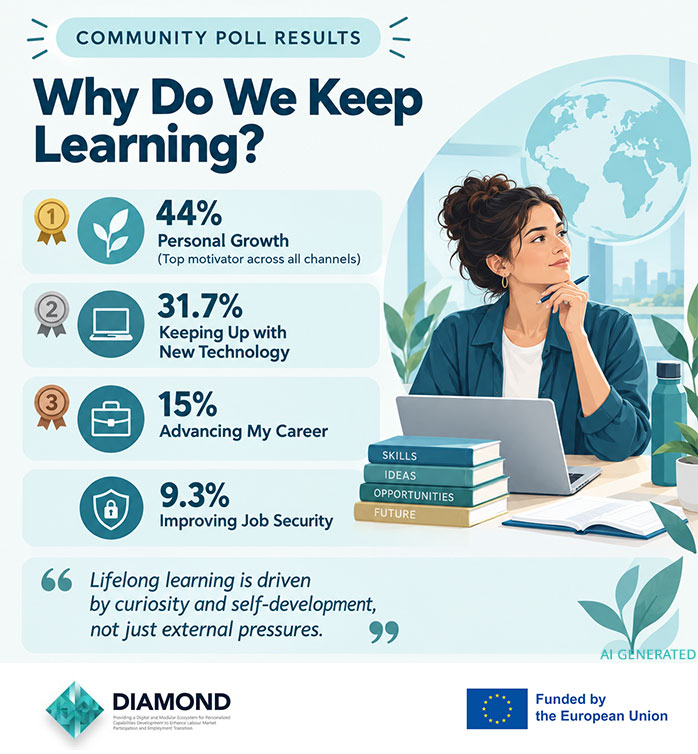
Across our social media channels, responses formed a remarkably consistent hierarchy:
- 🥇 Personal Growth (44.0%): Nurturing curiosity, building self-confidence, and cultivating critical thinking beyond a narrow job description.
- 🥈 Keeping Up with New Technology (31.7%): Mastering emerging digital tools, software workflows, and automation systems.
- 🥉 Advancing My Career (15.0%): Acquiring capabilities required to earn promotions or pivot into new professional sectors.
- 🔹 Improving Job Security (9.3%): Building defensive safeguards against macroeconomic instability or redundancies.
Beyond Fear: The Primacy of Personal Agency
The most striking insight from this survey is the contrast between personal growth (44.0%) and job security (9.3%).
Defensive panic does not sustain meaningful education. When upskilling initiatives rely on anxiety over displacement, participants frequently experience disengagement and burnout. Conversely, learners demonstrate exceptional resilience when they view education as an investment in their personal agency.
Furthermore, technical curiosity remains high. The 31.7% of respondents focused on technology want practical mastery. They view digital tools not as existential threats, but as instruments that expand their everyday creative and problem-solving capacities.
Therefore, effective training environments must bridge technical utility with personal meaning.
Key Takeaways for Educators and Employers
Designing impactful training requires moving beyond compliance checklists:
- Center Curiosity Over Compliance: Position new skills as tools for self-expression and professional empowerment rather than mandatory corporate requirements.
- Normalize the Beginner Mindset: Create psychologically safe learning spaces where experienced workers feel comfortable making mistakes with new technologies.
- Connect Digital Skills to Everyday Outcomes: Ground technical instruction in real-world workflows that visibly reduce daily friction for the learner.
Explore DIAMOND Resources and Research
The modern workplace will continue to change, but genuine curiosity remains an enduring asset.
Explore the ᴱGROW Index: https://diamond-empower.eu/e-grow-index/
Official Website of the EU-Horizon Project DIAMOND: https://diamond-empower.eu/
Consortium Partners:
- Aarhus Universitet (Coordinator)
- Freie Universität Berlin
- Universidad de Burgos
- Rheinisch-Westfälische Technische Hochschule Aachen
- Universität Wien
- CETIC
- Immersion
- European Centre for Economic and Policy Analysis and Affairs
- Evolutionary Archetypes Consulting SL
- Proportional Message Associacao
- Ente Morale Giacomo Feltrinelli per l’incremento Dell’Istruzione Tecnica
- Deinde Spolka Z Ograniczona Odpowiedzialnoscia
- Fundacja Obiektywna
- Youth Power Germany EV
- Fundación Miradas
Funding Agency: European Research Executive Agency (REA)
Project: 101178081 — DIAMOND — HORIZON-CL2-2024-TRANSFORMATIONS-01
Disclaimer: Funded by the European Union.
Views and opinions expressed are however those of the author(s) only and do not necessarily reflect those of the European Union or the European Research Executive Agency (REA).
Neither the European Union nor the granting authority can be held responsible for them.