Policy Meets Practice: Why Immersive Technology Governance Matters
Immersive technologies are moving rapidly from experimentation into everyday use. Augmented reality (AR), virtual reality (VR), mixed reality (MR), digital twins and virtual worlds are already changing how people learn, work and interact with digital information.
Across healthcare, manufacturing, education and other sectors, their potential is significant. However, their growing use also raises questions about safety, privacy, accessibility and responsible design.
That makes immersive technology governance increasingly important.
As adoption accelerates across Europe and beyond, one question deserves particular attention: Are governance frameworks and public policies keeping pace with immersive technologies?
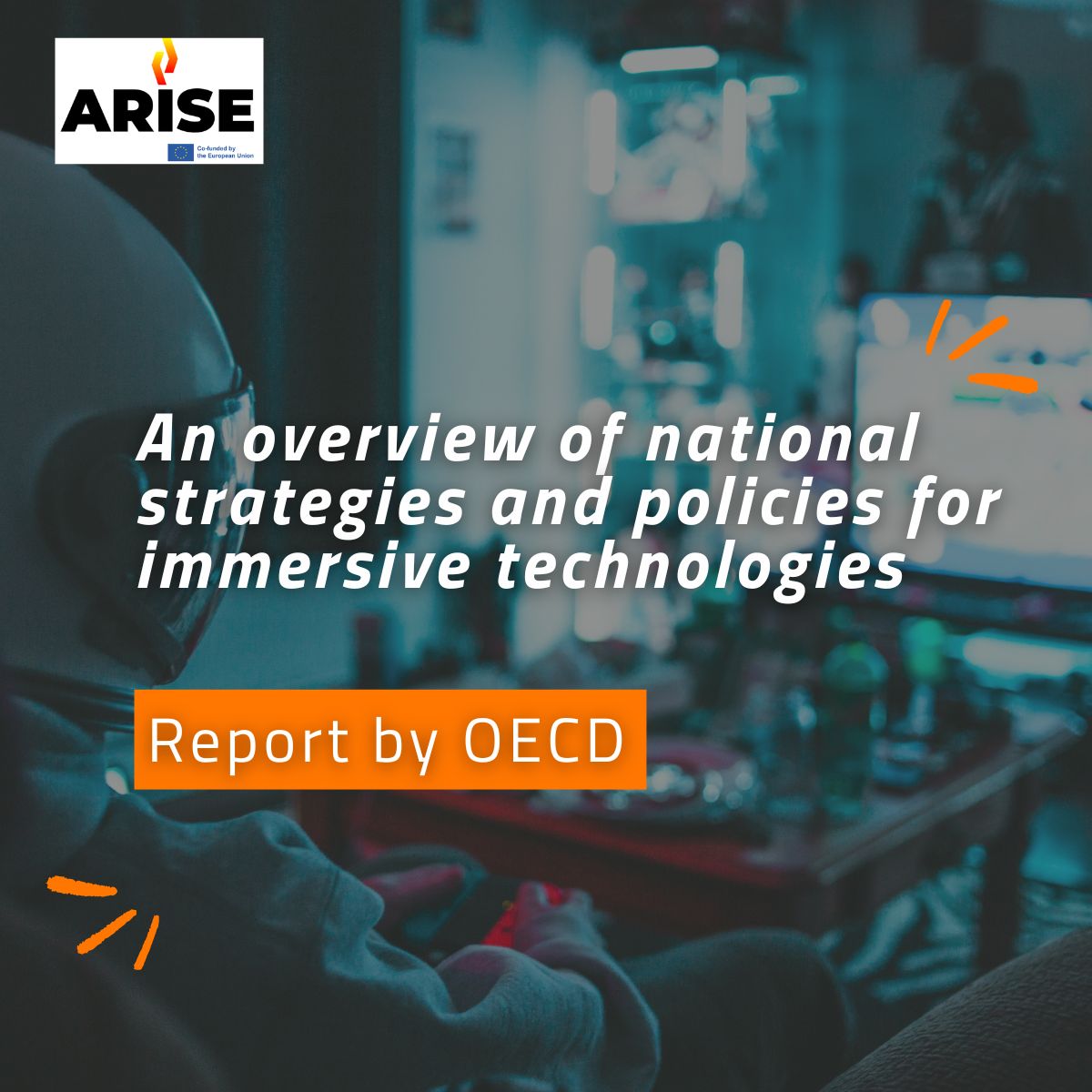
A recent analysis by the Organisation for Economic Co-operation and Development (OECD) examines 53 national and sub-national policies across 23 countries and the European Union.
The findings show just how recently this policy landscape has developed. According to the OECD, 70% of the policies identified were introduced in 2020 or later.
At the same time, policymaking remains fragmented. Governments have largely focused on supporting the development and deployment of immersive technologies rather than introducing regulations specifically designed to address their risks.
Five Core Approaches to National Immersive Tech Policy
The OECD analysis identifies five dominant approaches across the countries examined:
- Targeted funding: Governments provide direct financial support for projects specifically developing or applying immersive technologies.
- Non-targeted funding: Broader funding programmes support digital transformation and emerging technologies, with immersive technologies included among the areas eligible for support.
- Digital technology ecosystem support: Policies strengthen the wider conditions needed for immersive technologies to develop. This can include infrastructure, skills, technical standards and support for innovation ecosystems.
- National and regional strategies: Governments establish longer-term plans for developing and deploying immersive technologies as part of wider economic and digital priorities.
- Guidance and policy principles: Voluntary frameworks promote values such as trustworthiness, safety and security in the development and use of immersive technologies.
How ARISE Bridges Policy, Ethics, and Technical Skills
For Evolutionary Archetypes Consulting SL and 28DIGITAL, the OECD analysis directly aligns with the mission of the ARISE project.
Bridging the gap between cutting-edge technology and real-world deployment requires more than technical skills. It also requires human-centred design, accessibility, and an understanding of the wider social and ethical implications of immersive technologies.
Through collaboration across European academic institutions and industry leaders, ARISE provides specialised master’s modules, professional development courses, and e-learning resources that prepare future engineers, designers, and educators to:
- Implement responsible, human-centred XR interfaces that prioritise user safety and psychological wellbeing.
- Navigate European digital governance regulations, including data protection and algorithmic transparency.
- Develop interoperable digital twin and mixed-reality solutions suited for sustainable industrial applications.
As national strategies continue to evolve, initiatives like ARISE ensure that Europe’s workforce is equipped with the critical capabilities needed to lead the next generation of spatial technologies safely, equitably, and effectively.
Read the full report: https://www.oecd.org/content/dam/oecd/en/publications/reports/2026/02/an-overview-of-national-strategies-and-policies-for-immersive-technologies_c1bf93e7/2da1d7da-en.pdf
Official Website of the EU-Co-Funded Project ARISE: https://28digital.eu/eu-collaborations/arise
Consortium Partners:
- 28DIGITAL (28DGTL)
- Aalto University (AALTO)
- Universidad Politécnica de Madrid (UPM)
- KTH Royal Institute of Technology (KTH)
- Politecnico di Milano (POLIMI)
- University of Twente (UT)
- Linköping University (LIU)
- University of Trento (UNITN)
- Evolutionary Archetypes Consulting SL (EAC)
- Tech Valley Management (TECHVALLEY)
- University of Rennes (UNIVREN)
- Université Libre de Bruxelles (ULB)
- Fifth Ingenium (FIFTH)
Project Number: 101225600 — ARISE — DIGITAL-2024-ADVANCED-DIGITAL-07-KEYCAPACITY
Co-funded by the European Union. Views and opinions expressed are however those of the author(s) only and do not necessarily reflect those of the European Union or HADEA. Neither the European Union nor the granting authority can be held responsible for them.