Why Do Paved Surfaces Increase Surface Runoff?
In our latest ECOLUTION Project quiz, we asked:
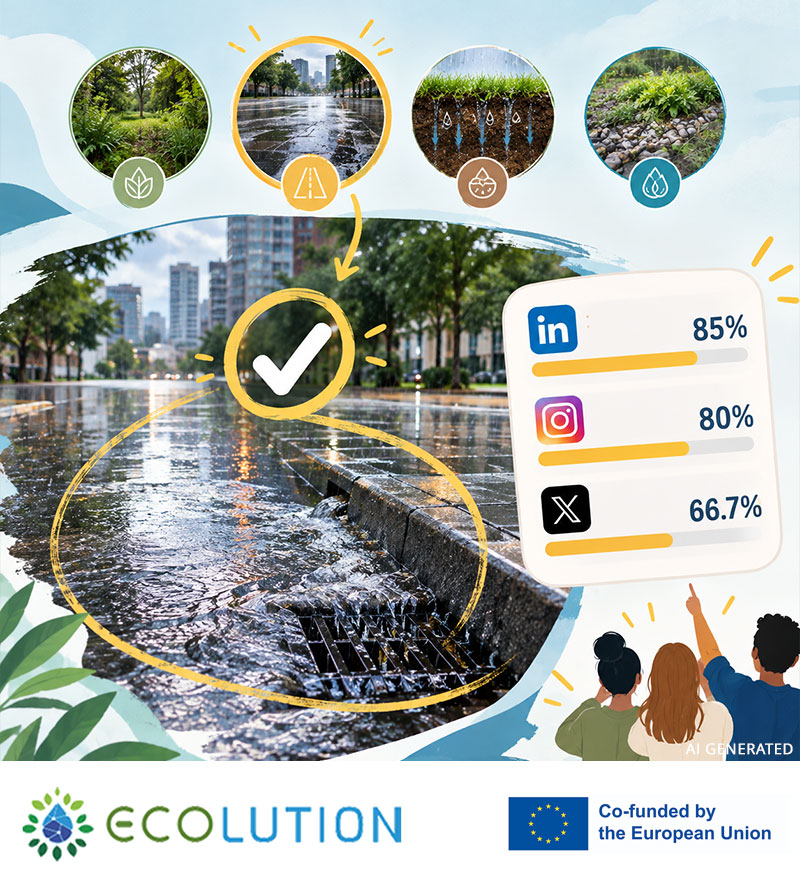
Which change is most likely to increase surface runoff after heavy rainfall?
The results showed a clear favorite. 85% of respondents on LinkedIn, 80% on Instagram, and 66.7% on X selected more paved surfaces.
And they were right.
But why does the surface beneath our feet make such a difference to where rainwater goes?
What Happens When Rain Reaches the Ground?
Rainwater can follow different pathways once it reaches the land surface. Some water enters the soil through infiltration, while water that remains at the surface can move across the landscape as surface runoff.
How much water follows each pathway depends on several factors, including rainfall conditions, soil characteristics, vegetation, and the nature of the land surface.
This means that changing the surface itself can also change the way water moves through an area.
Paving Changes the Surface
Natural and permeable surfaces allow water to enter the ground to varying degrees. Paving introduces an impervious surface, restricting this interaction between rainfall and the soil underneath.
This process is closely related to soil sealing.
The European Commission’s European Soil Data Centre (ESDAC) defines soil sealing as the loss of soil resources caused by covering land for housing, roads, or other construction. More specifically, it describes soil sealing as covering the soil surface with impervious materials as a result of urban development and infrastructure construction.
ESDAC also highlights an important consequence for the wider environment: surrounding soils can be affected by changes in water-flow patterns.
Source: European Commission / Joint Research Centre – European Soil Data Centre, Soil Sealing
Why Does This Matter for Surface Runoff?
The relationship becomes clearer when we return to our quiz question.
A paved surface creates a barrier between rainfall and the soil below. With less opportunity for water to enter the ground, a greater proportion can remain at the surface and contribute to runoff.
This is why “more paved surfaces” was the correct answer.
The other options point in the opposite direction. Greater infiltration means that more water is entering the soil rather than remaining at the surface. More permeable soil similarly provides greater opportunities for water to infiltrate. Vegetation can also influence how rainfall is intercepted and how water interacts with the soil.
The question therefore highlights something important about hydrology: rainfall alone does not determine what happens during a rainfall event. The characteristics of the landscape receiving that rainfall matter too.
Water, Land, and Environmental Change
Understanding these interactions is particularly relevant when considering changes in land use.
The European Soil Data Centre notes that soil sealing is particularly evident in urban and metropolitan areas, where development can replace open soil with buildings, roads, and other infrastructure. It also identifies land-use planning as an important factor in determining the progression of soil sealing.
Looking at rainfall and runoff alongside these changes helps us understand how human modifications to the landscape can affect natural environmental processes.
Hydrology in the ECOLUTION Project
These relationships connect with Hydrological and Climate Variability in the ECOLUTION MSc.
Studying hydrological systems involves understanding how water moves through the environment and how processes such as precipitation, infiltration, and runoff interact with soil, vegetation, land use, and climatic conditions.
The quiz may have started with a simple question about paved surfaces, but the answer points towards a broader environmental challenge: understanding how changes to our landscapes influence the movement of water.
Thanks to everyone who took part in this round of the ECOLUTION MSc quiz!
Funding Agency: EACEA – European Education and Culture Executive Agency
Learn more about ECOLUTION: https://www.ecolutionmsc.eu/
101140050 — ECOLUTION — ERASMUS-EDU-2023-PI-ALL-INNO
Disclaimer: Funded by the European Union. Views and opinions expressed are however those of the author(s) only and do not necessarily reflect those of the European Union or the European Education and Culture Executive Agency (EACEA). Neither the European Union nor EACEA can be held responsible for them.