How do you encourage engineering students to think beyond technical specifications and consider the real-world impact of their ideas?
One approach is to challenge them to solve meaningful problems while working in teams, drawing on both technical knowledge and entrepreneurial thinking.
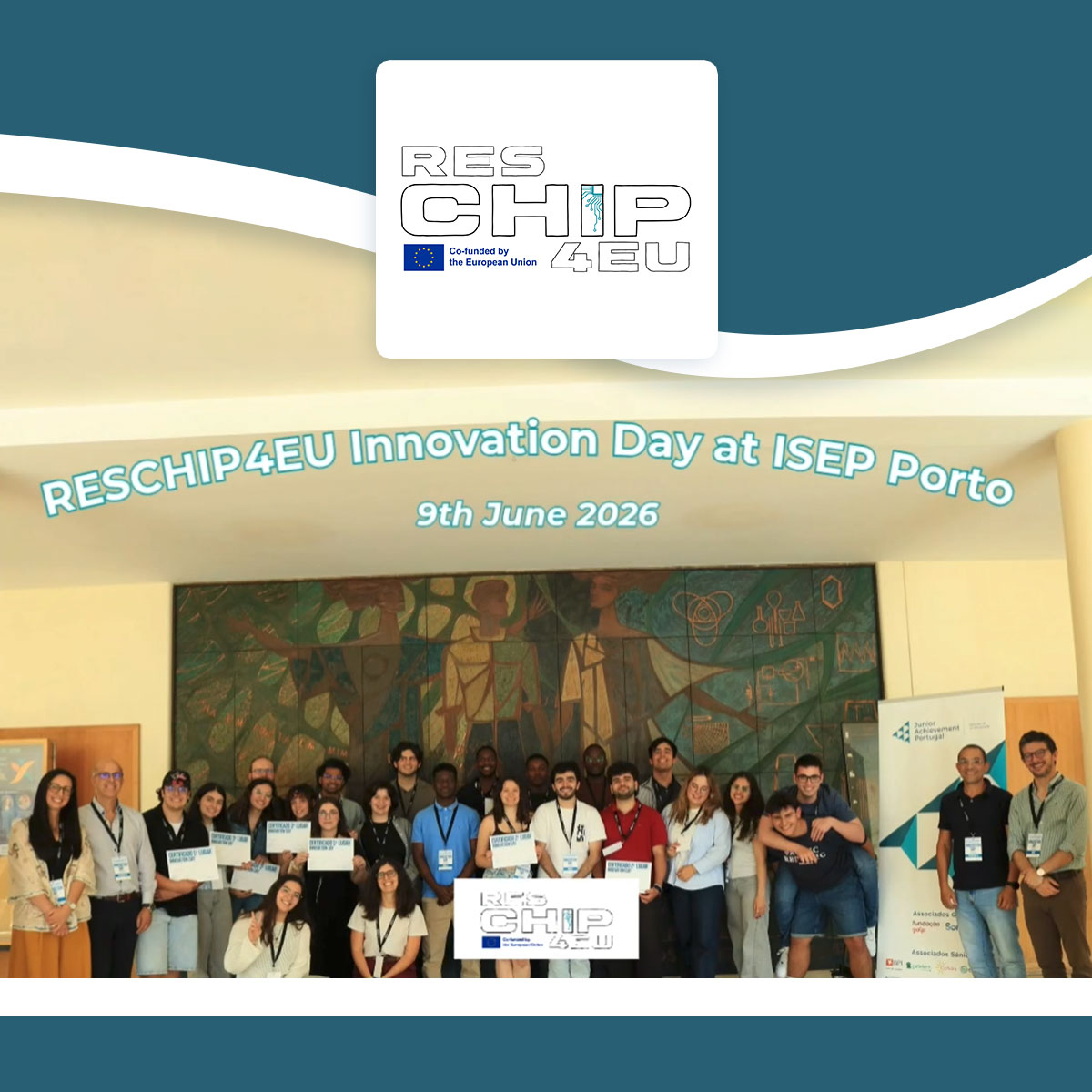
That was the focus of the RESCHIP4EU Innovation Day, held on 9 June 2026 at the Instituto Superior de Engenharia do Porto (ISEP) in Porto, Portugal.
Organised as part of RESCHIP4EU, the one-day challenge brought together 20 Bachelor’s-level engineering students to explore how microelectronics can address societal needs. The activity was organised in collaboration with 28DIGITAL and Junior Achievement Europe, creating an environment where students could combine technical expertise with creativity, teamwork, and innovation.
Working in teams, participants were challenged to design a product or service built around a low-power, low-cost embedded device using on-device artificial intelligence or edge intelligence. Rather than focusing solely on technological novelty, students were encouraged to think about usability, value creation, and the broader relevance of their ideas.
Throughout the day, students moved through different stages of the innovation process.
The programme included:
- Introducing the challenge and defining the problem space
- Team brainstorming sessions
- Developing ideas using the Business Model Canvas
- Receiving mentoring and feedback
- Refining concepts through iteration
- Presenting their ideas during final pitches
This structure allowed participants to experience a condensed version of the innovation journey, moving from an initial idea to a more developed concept supported by both technical and business considerations.
One of the most striking outcomes of the day was the direction chosen by the students themselves.
Although teams had the freedom to explore different applications, all five groups focused on health-related challenges in Portugal. Their ideas demonstrated a strong sense of purpose and reflected an understanding that semiconductor technologies have the potential to improve people’s everyday lives.
The winning team, NeuroPatch, stood out for both its creativity and societal relevance.
Their concept proposed a microchip designed to be implanted behind the ear to help detect and prevent epilepsy episodes. The idea highlighted how emerging technologies can be applied to address significant health concerns while encouraging students to think about the practical implications of their work.
Beyond the competition element, the Innovation Day also reflected the collaborative approach that underpins RESCHIP4EU.
By bringing together students, mentors, industry representatives, researchers, and project partners, the activity created opportunities for emerging talent to engage directly with innovation-focused experiences and gain insight into Europe’s evolving semiconductor landscape.
Engineers increasingly need to communicate ideas clearly, work across disciplines, understand user needs, and recognise how technology intersects with wider societal challenges. Providing opportunities to practise these skills early in their academic journeys helps students build confidence and broaden their perspectives on what their future careers might involve.
At Evolutionary Archetypes Consulting SL (EAC), we value initiatives that connect education, innovation, and emerging talent across Europe’s semiconductor ecosystem. Activities like the RESCHIP4EU Innovation Day encourage students to explore how their technical expertise can contribute to meaningful solutions while developing the collaborative and entrepreneurial mindset needed in rapidly evolving fields.
Learn more about RESCHIP4EU: https://28digital.eu/eu-collaborations/reschip4eu
Project Number: 101158828 — RESCHIP4EU — DIGITAL-2023-SKILLS-04
Disclaimer: Co-Funded by the European Union. Views and opinions expressed are however those of the author(s) only and do not necessarily reflect those of the European Union or HADEA. Neither the European Union nor the granting authority can be held responsible for them.