
Why Verification Matters Before Code Is Written
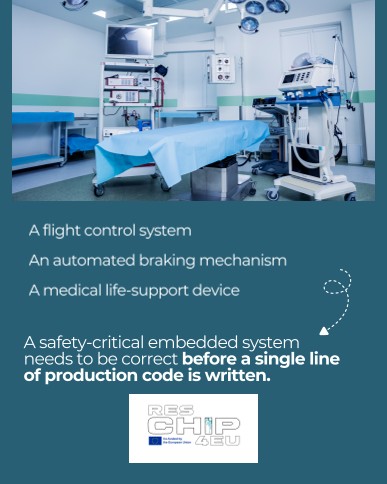
When people think about software and embedded systems development, they often focus on programming. However, in many safety-critical environments, a significant amount of work takes place before any production code is written.
The Model-Based Design and Verification module featured by RESCHIP4EU introduces the methods engineers use to design, analyse, and verify complex embedded systems. These approaches are particularly important in sectors where reliability and safety are essential, including transportation, industrial automation, aerospace, and healthcare technologies.
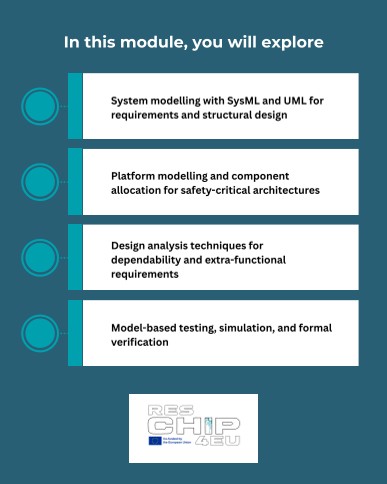
The course explores how system modelling languages such as SysML and UML can be used to define requirements, describe system architectures, and analyse component interactions. Learners are also introduced to techniques for platform modelling, component allocation, and the evaluation of dependability and extra-functional requirements.
A key focus of the module is verification. Through testing, simulation, and formal verification methods, engineers can identify issues and validate system behaviour before deployment. This helps reduce development risks and supports the creation of systems that meet strict functional and safety requirements.
The course consists of 11 lessons, 51 topics, and 9 quizzes, and is available free of charge with a certificate upon completion. It forms part of the broader educational activities developed through RESCHIP4EU, which aims to strengthen advanced skills in chip design, microelectronics, and embedded systems across Europe.

As partners, Evolutionary Archetypes Consulting SL and 28DIGITAL support initiatives that help learners gain practical knowledge and specialised expertise in areas that are increasingly important for Europe’s digital future.
Explore the course: Model Based Design and Verification
Learn more about RESCHIP4EU: https://28digital.eu/eu-collaborations/reschip4eu
Project Number: 101158828 — RESCHIP4EU — DIGITAL-2023-SKILLS-04
Disclaimer: Co-Funded by the European Union. Views and opinions expressed are however those of the author(s) only and do not necessarily reflect those of the European Union or HADEA. Neither the European Union nor the granting authority can be held responsible for them.