Introduction to Space Architecture: Culture, Meaning, and Habitats Beyond Earth
When we picture a lunar base or a Mars habitat, engineering equations and radiation shielding usually come to mind first. Yet the places humans inhabit have never been purely technical machines for staying alive. From the earliest shelters on Earth to orbital stations, architecture has always expressed cultural identity, social values, and shared human meaning.
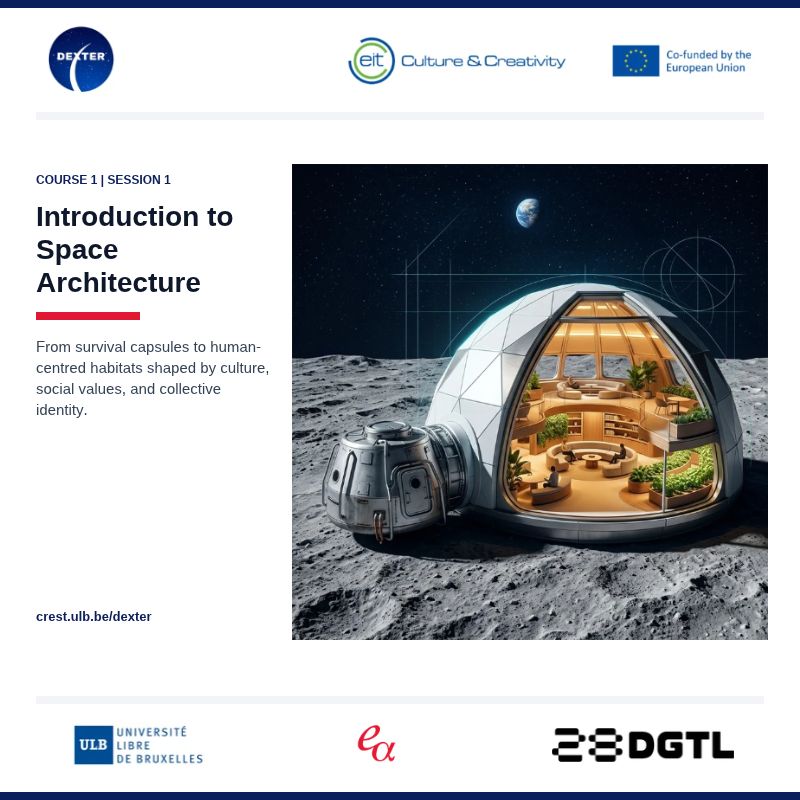
That human-centred lens opens Course 1: Creative Horizons in the DEXTER Master Class. Its opening module, Session 1: Introduction to Space Architecture (6 hours), invites doctoral researchers, designers, and engineers to trace how habitats evolve and reimagine architecture as a cultural narrative beyond Earth.
From Survival Capsules to Meaningful Living Spaces
Early spaceflight demanded compact, utilitarian modules focused exclusively on keeping crews alive in vacuum and microgravity. As missions shift from short orbital stays toward sustained lunar and planetary settlements, that survival-only mindset is no longer enough.
Session 1 examines how space habitats have evolved over time and why spatial proportions, light, thresholds, and communal areas directly shape human dignity and collective life in extreme isolation. Rather than treating crew quarters as passive containers, learners analyse how design choices communicate purpose, belonging, and cultural continuity.
Architecture as Culture on Earth and in Orbit
Guided by academic leadership from CCREST – Centre for Research and Engineering in Space Technologies (Université libre de Bruxelles), this six-hour lesson connects architectural history with future-facing aerospace practice.
Within the DEXTER consortium, Evolutionary Archetypes Consulting SL (EAC) provides the DEXTER e-learning platform and shapes pedagogical design and strategic dissemination, while 28DGTL connects the programme with Europe’s wider digital innovation ecosystem.
Studying architecture as cultural expression in extreme environments also sharpens how we design here on Earth. Designing for scarcity, remote communities, and high-stress conditions encourages resilient, resource-conscious buildings that respect both people and place.
Explore the curriculum and access the DEXTER e-Learning Platform: https://28digital.ea.education/dexter/
Official Website of the EU-Co-Funded Project DEXTER: https://crest.ulb.be/dexter/
Consortium Partners:
- CREST – Centre for Research and Engineering in Space Technologies (Université libre de Bruxelles)
- Evolutionary Archetypes Consulting SL (EAC)
- 28Digital (28DGTL)
Funding Agency: European Institute of Innovation and Technology (EIT)
Programme: EIT Culture & Creativity
Project KAVA Code: 062600033
Co-funded by the European Union. Views and opinions expressed are however those of the author(s) only and do not necessarily reflect those of the European Union or the EIT. Neither the European Union nor the granting authority can be held responsible for them. EIT Culture & Creativity is supported by the European Institute of Innovation and Technology (EIT), a body of the European Union.