The EU’s New Plastic Waste Export Ban: Why Smart Environmental IoT Matters Now
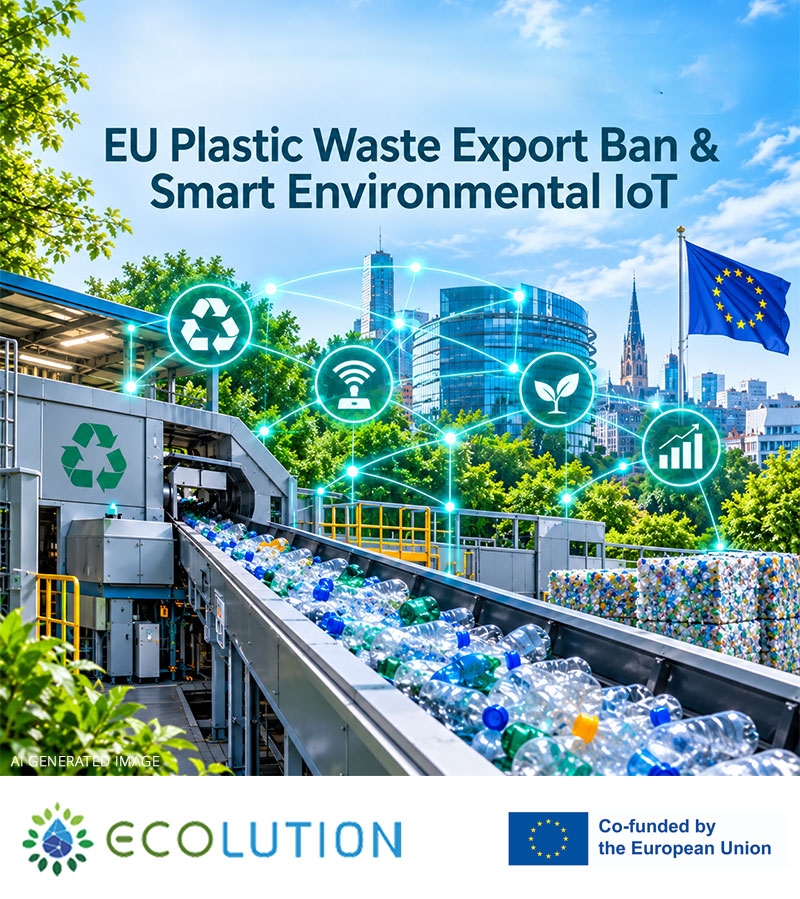
On 21 November 2026, a new regulation for Europe’s circular economy officially entered into force: under the revised EU Waste Shipments Regulation (EU) 2024/1157, the European Union banned exports of plastic waste to non-OECD countries.
This regulation was designed to stop the EU from shifting environmental and waste burdens onto third countries. this measure applies across all plastic waste streams. This includes clean, non-hazardous plastic scrap destined for recycling. The regulation will remain in place until at least 21 May 2029. Exports to OECD countries remain permitted only under stricter monitoring and regulatory oversight by the European Commission.
Why Domestic Responsibility Demands Smarter Infrastructure
Keeping plastic waste inside Europe is an important environmental milestone, but legislation alone does not build circular value chains. Processing higher volumes of secondary raw materials domestically puts immediate pressure on municipalities, recycling operators, and industrial supply chains to improve sorting accuracy, trace material flows, and reduce contamination.
This is where digitalisation meets environmental engineering. Connected Internet of Things (IoT) sensors, real-time waste-stream monitoring, automated sorting telemetry, and data-driven logistics turn circular economy targets into measurable, scalable operations.
How ECOLUTION Prepares Engineers for Europe’s Circular Transition
Bridging policy ambition with technical execution requires specialists who understand both ecological systems and connected digital technologies. The ECOLUTION MSc (The mastErs COurse on smart sustainability soLUTIONs) trains enrolled Master’s students across Europe to design smart environmental systems – combining international academic modules, on-site laboratory mobility, and hands-on industrial practice with European partners.
As regulations like the EU Waste Shipments Regulation reshape how Europe manages resources, graduates equipped with both environmental knowledge and IoT engineering skills will play a decisive role in turning regulatory milestones into cleaner, circular cities and industries.
Sources and Project Links
European Commission – Waste Shipments: https://environment.ec.europa.eu/topics/waste-and-recycling/waste-shipments_en
Official Text of Regulation (EU) 2024/1157 (EUR-Lex): https://eur-lex.europa.eu/eli/reg/2024/1157/oj
Official Website of the Erasmus+ Project ECOLUTION: https://www.ecolutionmsc.eu/
Funding Agency: EACEA – European Education and Culture Executive Agency (https://www.eacea.ec.europa.eu/)
Project: 101140050 – ECOLUTION – ERASMUS-EDU-2023-PI-ALL-INNO
Disclaimer: Funded by the European Union. Views and opinions expressed are however those of the author(s) only and do not necessarily reflect those of the European Union or the European Education and Culture Executive Agency (EACEA). Neither the European Union nor EACEA can be held responsible for them.