HPC Centre or Cloud? How They Work, What They Cost, and the Skills They Require
Modern scientific and industrial work demands far more computing power than a standard workstation can deliver. Tasks like climate modelling, physics simulations, and AI model training require heavy infrastructure, leaving research teams with two primary choices: a public High-Performance Computing (HPC) centre or a commercial cloud provider.
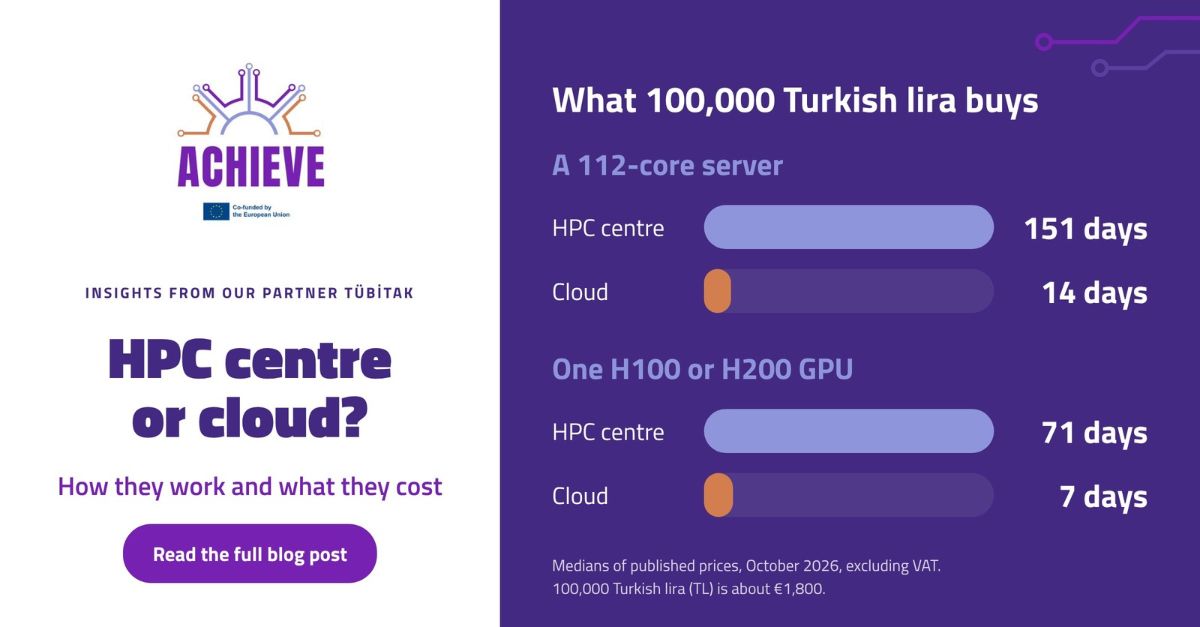
In a recent blog post, Selcuk Bilmis from TÜBİTAK (Scientific and Technological Research Council of Turkey), a consortium partner in the ACHIEVE project, compared the published prices of 13 public HPC centres against three commercial cloud providers. His analysis found that at list prices, the same budget buys roughly 10 times more computing time at an HPC centre.
Why the Cost Gap Exists
The price difference comes down to how each infrastructure is funded and operated:
- Public HPC Centres: Built upfront with public funding so researchers do not pay for the hardware twice. They typically recover only part of their running costs and do not operate to generate a profit.
- Commercial Cloud Providers: Recover every expense through hourly pricing, including hardware, buildings, staff, support services, and profit margin. In exchange, cloud platforms launch machines within minutes with no application process, no job queue, no strict runtime limits, and instant scaling on demand.
Deciding between dedicated HPC, commercial cloud, or a hybrid mix depends on workload size, urgency, and budget. However, hardware access alone does not solve the bottleneck. Organisations also need engineers and researchers who understand how to deploy, optimise, and manage workloads across both environments.
As highlighted in Selcuk Bilmis’s article, ACHIEVE directly addresses this skills gap across Europe. Coordinated by 28DIGITAL, the ACHIEVE initiative combines a double-degree Master’s programme with the EIT Digital Master School in Cloud and Networking Infrastructure with an HPC specialisation, alongside short online modules designed for working professionals.
Read Selcuk Bilmis’s full comparison on his blog: https://sbilmis.org/blog/hpc-or-cloud.html
Official Website of the EU-Co-funded project ACHIEVE: https://28digital.eu/eu-collaborations/achieve
Consortium Partners:
- 28DIGITAL (28DGTL)
- 28DIGITAL Spain (28DGTL ES)
- University of Trento (UNITN)
- Middle East Technical University (METU)
- University of Rennes (UR)
- KTH Royal Institute of Technology (KTH)
- Babeș-Bolyai University (UBB)
- Aalto University (AALTO)
- Polytechnic University of Milan (POLIMI)
- University of Novi Sad (UNS FTN)
- Evolutionary Archetypes Consulting SL (EAC)
- Techvalley Management (TECHVALLEY)
- Infineon Technologies (INFINEON)
- ODTÜ Teknokent (OBTUTEK)
- Scientific and Technological Research Council of Turkey (TUBITAK)
Associated Partners
- Research Institutes of Sweden (RISE)
- Amazon Web Services (AWS)
Funding Agency: European Health and Digital Executive Agency (HaDEA)
101190015 – ACHIEVE – DIGITAL-2023-SKILLS-05
Disclaimer: Co-Funded by the European Union. Views and opinions expressed are however those of the author(s) only and do not necessarily reflect those of the European Union or HADEA. Neither the European Union nor the granting authority can be held responsible for them.