Why Do ECOLUTION Students Learn Remote Sensing & Wireless Sensor Networks?
How do environmental managers detect soil degradation, forest stress, or hydrological changes before lasting damage occurs?
Traditionally, ecological fieldwork has relied on manual inspections and retroactive assessments, often identifying environmental degradation only after ecosystems have suffered critical stress. However, as climate pressures intensify, managing natural resources requires immediate, evidence-based data.
To address this challenge, the ECOLUTION ProjectMaster’s Programme (MSc in Ecological Transition and Circular Economy) equips students with digital tools designed for active monitoring. Central to this training is course 1W5: Remote Sensing & Wireless Sensor Networks.
Understanding the Principles of Remote Sensing
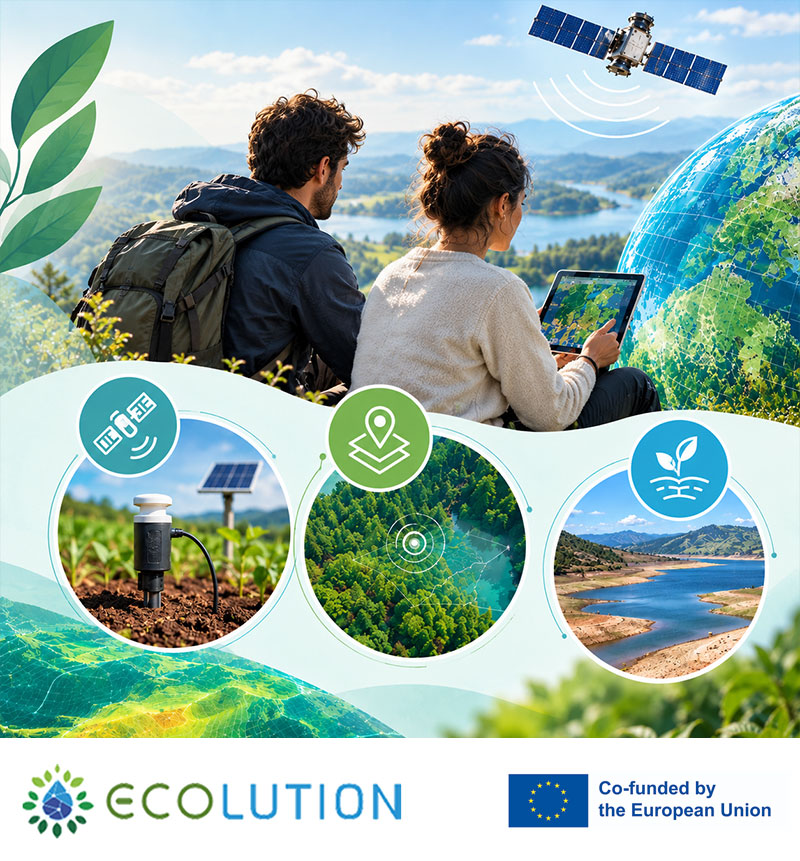
Remote sensing allows scientists to capture information about the Earth’s surface from a distance using satellite imagery and aerial observation.
Within the ECOLUTION Project curriculum, students examine the physical principles and analytical methods behind modern Earth Observation:
- Satellite Imagery Processing: Analysing multi-spectral data to track vegetation dynamics, forest canopy changes, and land-use shifts.
- Environmental Health Indicators: Measuring soil moisture patterns, crop vitality, and surface temperature anomalies across broad geographical areas.
- Longitudinal Monitoring: Comparing multi-temporal datasets to evaluate how ecosystems respond to changing regional conditions over months and years.
Through hands-on coursework, students develop the practical capability to transform raw satellite data into clear spatial representations of environmental health.
Bridging the Skies and the Soil: Integrating Wireless Sensor Networks
While satellite imagery offers wide geographical coverage, effective environmental management also requires high-precision ground measurements. Course 1W5 directly bridges this gap by combining satellite observation with Wireless Sensor Networks (WSNs).
Wireless sensor networks consist of spatially distributed, autonomous sensors that collect real-time physical and chemical data directly from the field.
Students learn to integrate both data streams to address specific ecological challenges:
- Ground-Truthing Satellite Data: Validating satellite spectral readings with localised in-situ measurements taken directly from soil probes and microclimate stations.
- Targeted Environmental Monitoring: Deploying sensor arrays to track microclimate shifts, water table variations, and localised pollution levels.
- Precision Agriculture & Conservation: Providing accurate data to optimise water distribution, reduce chemical runoff, and support biodiversity corridors.
Connecting Digital Competence with Sustainable Land Governance
Learning technical tools in isolation is not enough. The core objective of ECOLUTION Project is to connect digital methodologies directly to sustainability policy and landscape protection.
By pairing Course 1W5 with complementary modules such as Geospatial Data Sciences (Course 2W2) and Sustainable Land Management (Course 1W4), students learn to translate complex data points into actionable management plans. Graduates leave the programme prepared to advise agricultural enterprises, public conservation authorities, and international bodies with verifiable, scientific evidence.
As European environmental frameworks place greater emphasis on measurable outcomes, professionals who understand both digital systems and natural habitats are essential to guiding Europe’s green transition.
Official Website of the Erasmus+ Project ECOLUTION: https://www.ecolutionmsc.eu/
Funding Agency: EACEA – European Education and Culture Executive Agency
101140050 — ECOLUTION — ERASMUS-EDU-2023-PI-ALL-INNO
Disclaimer: Funded by the European Union. Views and opinions expressed are however those of the author(s) only and do not necessarily reflect those of the European Union or the European Education and Culture Executive Agency (EACEA). Neither the European Union nor EACEA can be held responsible for them.