
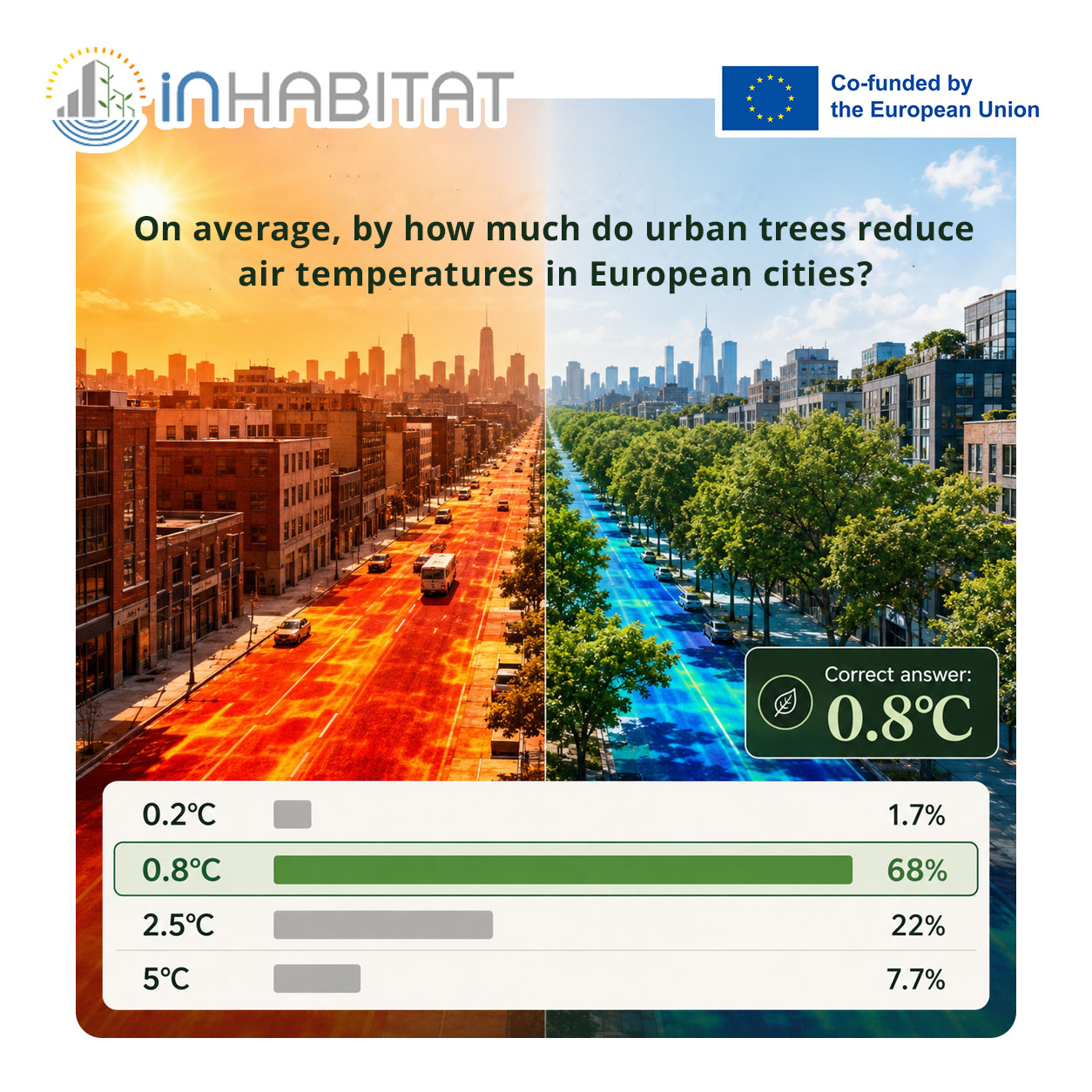
A few weeks ago, we put a summer question to the INHABITAT Project community:
On average, by how much do urban trees reduce air temperatures in European cities?
The possible answers ranged from just 0.2°C to 5°C, and the results showed just how difficult the effect of urban trees can be to estimate.
Across LinkedIn, Instagram and X, the average percentage selecting the correct answer was 68%. However, the results varied considerably between platforms. On Instagram, 75% selected the correct answer, while all responses on X did the same. LinkedIn told a very different story: only 29% chose the correct answer, while 41% selected 2.5°C and another 23% chose 5°C.
So, what is the correct answer?
The Answer: 0.8°C
According to the European Commission, a study covering more than 600 European cities found that urban trees reduce air temperatures by an average of 0.8°C, with even greater cooling effects recorded in some locations.
The LinkedIn results are particularly interesting in this context. Almost two-thirds of respondents there expected trees to produce a larger average reduction, selecting either 2.5°C or 5°C.
But how do trees actually produce this cooling effect?
More Than Just Shade
The most obvious answer is shade. Anyone who has looked for a tree on a hot summer afternoon knows the immediate difference that avoiding direct sunlight can make.
But according to the European Commission, trees also cool their surroundings through evapotranspiration. This is the natural process through which plants release water vapour into the atmosphere, contributing to cooler surrounding air.
Together, shade and evapotranspiration make trees what the Commission describes as highly effective natural cooling systems. Their role becomes particularly relevant in urban environments, where concrete, asphalt and other surfaces absorb and retain heat.
The Commission therefore highlights incorporating nature into urban planning as one of the measures that can help make cities more resilient to extreme heat.
Cooling Is Only Part of the Picture
The European Commission also highlights how nature-based solutions can improve air quality, support biodiversity and reduce flood risk, while contributing to healthier and more liveable cities.
This means that adding nature to urban environments can address several challenges at the same time. Trees and other forms of green infrastructure are not simply aesthetic features of a city; they can play a practical role in how urban areas respond to environmental pressures.
For the INHABITAT Project, this is an important part of understanding sustainable urban environments. The relationship between nature and the built environment demonstrates how decisions about the spaces around us can influence the way cities respond to challenges such as extreme heat.
Our poll may have started with one simple number, but the answer tells a much broader story. 0.8°C might be lower than many of our LinkedIn respondents expected, yet the research shows that urban trees have a measurable cooling effect while providing benefits that extend well beyond temperature.
Sometimes the tree providing shade on a hot summer day is doing considerably more for the city around it than we realise.
Source: European Commission – 5 things you should know about extreme heat and how to beat it
Funding Agency: EACEA – European Education and Culture Executive Agency
Learn more about INHABITAT: https://www.inhabitatmsc.eu/
101108631 — INHABITAT — ERASMUS-EDU-2022-PI-ALL-INNO
Disclaimer: Funded by the European Union. Views and opinions expressed are however those of the author(s) only and do not necessarily reflect those of the European Union or the European Education and Culture Executive Agency (EACEA). Neither the European Union nor EACEA can be held responsible for them.